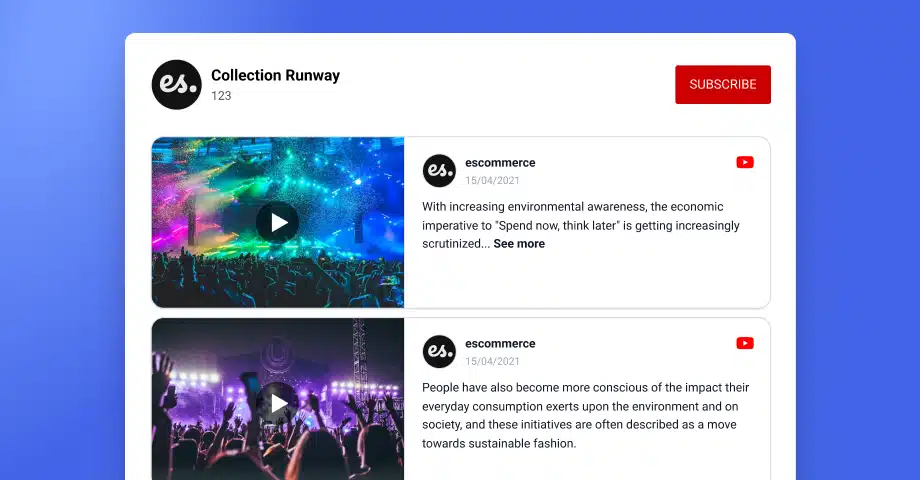

Embedding a YouTube playlist on your website is a great way to increase engagement and keep visitors watching longer. Instead of showing a single video, you create a binge-worthy experience that boosts time on page and strengthens your SEO signals.
The problem? Manually copying embed codes for every new video is slow, repetitive, and easy to forget. If your playlist updates often, your website quickly falls out of sync.
That said, YouTube does offer a native method to embed YouTube videos on websites, but the embedded widget only shows one video and cannot be customized.
That’s where EmbedSocial changes the game. With direct YouTube API integration, you can automatically sync and embed your YouTube playlist on your website, no coding, no manual updates, no constant copy-paste. Perfect YouTube widgets for you.
Here’s a brief video covering the process:
You can embed a full YouTube channel, a specific YouTube playlist, or even YouTube hashtagged videos. Once it’s connected, everything updates automatically.
How to find your YouTube playlist URL?
Before you embed YouTube playlist in website, you need the correct YouTube playlist URL. This link helps you connect it to a tool like EmbedSocial:
Here’s how to find it step by step:
- Navigate to the YouTube account: You can only embed public YouTube playlists, regardless of whether they are on your account or someone else’s;
- Open the ‘Playlists’ tab from the top ribbon: Here’s where you’ll find all playlists the YouTube channel in question has made public;
- Access the YouTube playlist you want to embed: Instead of clicking the YouTube playlist thumbnail, you have to tap ‘View full playlist’ underneath it;
- Copy the playlist URL from the URL bar: Once the playlist opens, copy the full URL from your browser’s address bar. That is your YouTube playlist URL.

Note: You can also embed unlisted YouTube playlists from your own channel.
Full guide: How to Embed a YouTube playlist via EmbedSocial?
Before embedding a YouTube playlist on your website, create your EmbedSocial trial account. Then, you can follow these steps to get your playlist website widget up and running:
- Describe your YouTube playlist widget with AI
- Connect your YouTube playlist source
- Select and apply a video template
- Further customize the YouTube widget via AI
- Copy the widget embed code
- Paste the code in your website editor
Step 1: Describe your YouTube playlist widget with AI
Write a text prompt describing how you want your YouTube playlist widget to look. You can be as specific as you want, related to colors, layout, and other elements:

Step 2: Connect your YouTube playlist source
Click on ‘Connect your source’ to link your YouTube account:

You can choose from several source types. In this case, go for the ‘Playlist’ option:

Step 3: Select and apply a video template (optional)
We also offer tons of different widget templates that are ready to go. If you lack the inspiration to start from scratch, you can choose one of our YouTube widget templates:

Check out all our YouTube widget templates.
Step 4: Further customize the YouTube widget via AI
Then, change anything you want on your current widget template:

Step 5: Copy the widget embed code
When you perfect your widget, head on over to the ‘Embed’ tab. Tap ‘Copy code’ to save it to your clipboard (you’ll need to paste it into your website builder):

Step 6: Paste the code in your website editor
Lastly, paste the YouTube playlist widget code on the page where you want it to appear. For instance, when using WordPress, you will only have to add an empty HTML block.
That’s all you had to do! Now, you’ll be boosting your brand’s social proof with user-generated content, and you’ll see more conversions because of that!
Learn more:
How to Embed YouTube Live on Your Website in 2026? (Step-by-Step Guide)
How to embed YouTube playlist on all popular website builders?
EmbedSocial works with all popular website builders and CMS platforms, so if you want to embed YouTube playlist on WordPress, you can. Plus, you can do it on all these CMS:
Official (limited) method: How to use the YouTube embed code?
If you are okay with the lack of customizations or flexibility offered by third-party UGC platforms like EmbedSocial, you can also use the native YouTube embed method.
Follow the same steps for locating the playlist in question, but instead of copying the URL from the address bar, you have to find the specific YouTube playlist embed code.
Then, tap the ‘Share’ arrow in the playlist in question, then ‘Embed’, and ‘Copy’ (bottom-right corner):

After using the YouTube playlist embed code generator, navigate to the specific page on your website, add an HTML element, and paste the code within.
Once you do that, you’ll get a widget like this:
As you can see, you cannot see all the videos in the playlist, and you can only watch them sequentially. EmbedSocial solves this problem wonderfully.
Here’s the same YouTube playlist embed example via EmbedSocial:
Why embed a YouTube playlist?
When you embed a YouTube video playlist on your website, you turn scattered videos into a structured social media feed. Instead of sending visitors back to YouTube, you keep them on your domain, watching more, engaging more, and converting more.
Here’s what happens when you embed a YouTube playlist on your website:
- Always-fresh content, every time you update your YouTube playlist, the embedded YouTube content on your website updates automatically through EmbedSocial, keeping your content current without having to embed videos manually;
- Example: a SaaS company adds a new product tutorial to its YouTube playlist, and the tutorial instantly appears on its Help Center page without touching the site code;
- Cleaner page design, embedding a single YouTube playlist instead of multiple videos keeps your layout organized and reduces visual clutter;
- Example: an online course page displays one embedded YouTube playlist for “Module 1” instead of ten separate video players stacked vertically;
- Higher video views & engagement, a YouTube playlist encourages sequential watching, increasing total video views and session duration;
- Example: a digital marketing agency embeds a “Case Studies” YouTube playlist, and visitors watch 3–4 success stories in one session instead of leaving after one video;
- Stronger SEO signals, rich media like an embedded YouTube playlist increases time on page and reduces bounce rate, both of which support organic rankings;
- Example: a blog post that embeds a YouTube playlist of tutorials keeps users on the page for 6 minutes instead of 1, improving behavioral SEO metrics;
- Automatic dynamic updates, once you embed a YouTube playlist using EmbedSocial, new videos sync instantly without re-embedding or copying new iframe codes;
- Example: a product launch playlist automatically expands with each new feature demo video added on YouTube;
- Better content control, you decide which videos appear by organizing them inside a YouTube playlist, rather than manually managing individual embeds.
- Example: a fitness coach creates separate YouTube playlists for “Beginner,” “Intermediate,” and “Advanced” workouts and embeds each on its matching landing page.
As you can see, embedding a YouTube playlist feed is about building a self-updating video library that improves engagement, strengthens SEO, and simplifies content management.
Embedding YouTube videos on your website: 9 Expert opinions
Here is what 9 thought leaders had to say about embedding video content on their website:
Video Embeds Drive Dwell Time And Trust
We see YouTube embeds to be part of our main engagement strategy because of the significance that dwell time gives search engines regarding how a person’s interaction with a piece of content can signal to them how well it serves user intent. So when a person stops to watch a two-minute explanatory video, it tells search engines that the person finds that content to be valuable.
According to research done by Wistia, adding video can increase the average time someone spends on a webpage up to 2.6 times (that’s a significant boost to organic authority).
The most common mistake I see in this area is “slapping” a video onto a page without concern for the effect it will have on performance. Standard iframes (embedded YouTube video players), which are created using HTML, are heavy and therefore can have a negative impact on Core Web Vitals. We always use “facades” to embed our videos, meaning that instead of just embedding a video using standard HTML “iframe” syntax, we first create and embed a high-quality image preview of the video, and then embed the actual video when the user clicks on that image. This allows us to display the high-quality image preview of the video immediately while maintaining the page load speed expected from your site. We always wrap each of our embeds in VideoObject schema markup; by not including and properly creating structured data, your video is virtually invisible to Google’s rich snippet crawler.
Ultimately, video provides a greater opportunity for building trust with your audience than text-based content. Giving your audience an avenue for receiving information that they prefer is a sure way to reduce bounce rates and enhance the overall perception of the brand.
It can be easy to get caught up in all the technical SEO advantages to using video content, but it is important to remember that video content has a humanizing impact (where you actually see someone talking to you or showing you a product in a live demo) that text on a page cannot provide. In the computer-only world of AI-generated content, that human connection between yourself and your audience can never be duplicated with all the text.
Amit Agrawal, Founder & COO, Developers.dev
-——————————————
Tutorial Videos Lift Engagement And Conversions Significantly
Yes, I use a boat load of Youtube videos on all my clients’ consumer facing websites like viralgrowth. com and LevelSurveys. com and the results are really massive - embed videos increase user engagement / time spent on site by up to 60-80% and also boosting our conversion rates for survey sign-ups, focus group registrations etc. My model would be the rather bespoke tutorial videos that are answering frequent questions people have around just how to get going with paid surveys, or meeting the criteria for research studies, displayed prominently on landing pages and faq areas where users need guidance most. I also make sure videos are optimized for mobile consumption as over 70% of our traffic is on mobile, and I use custom thumbnails that effectively convey the value proposition of the video in order to increase click-through rates.
Scott Brown, Founder, Focus Group Placement
-——————————————
Right Video Per Page Improves SEO
I embed video on client sites when it makes sense. Mostly YouTube. It keeps people on the page longer and Google notices that. Someone watches a 2 minute video instead of bouncing after 10 seconds, that sends a good signal.
With my contractor clients I’ll put a short video on their service pages. Doesn’t have to be anything crazy. A roofer walking a job site and talking through what he sees does better than some polished commercial every time. People want to see who they’re about to hire.
Biggest mistake I see is people embedding videos that don’t match the page. You land on a roof repair page and there’s some generic company intro, that’s not doing anything for you. Keep it simple. One page, one topic, one video that actually fits.
Also watch your page speed. I use lite embeds so the YouTube player doesn’t load until someone clicks play. Not worth tanking your load time over a video nobody might watch.
Tyler Henn, Owner, hennhouse
-——————————————
Lazy-Load Videos And Schema Boost SEO
I’ve found that embedding YouTube videos is a double-edged sword for SEO. To reap the benefits without the performance hit, our team always uses lazy loading. This strategy has greatly improved our page speed over standard embeds. It also captures the usual 41% increase in search traffic from video users.
Best Practice: We use lazy-loading videos and add VideoObject Schema markup to the page. Google indexes video markup, which helps our page rank higher than text-only pages. Any video must align with the page’s content. This tactic aims to maximize our visibility and increase the dwell time without hurting our Core Web Vitals.
Brandon Perton, Owner, The Old School Game Vault
-——————————————
Video Impact Varies: Test And Match Intent
Having executed SEO across diverse fields such as e-commerce, SaaS, local services, and B2B, I have observed that the impact of embedding videos on websites does not produce the same results across industries. They typically result in better outcomes for visually-oriented or trust-sensitive industries. E-commerce brands, product-led SaaS companies, health service providers, and home service businesses achieve better engagement and higher conversion rates when videos showcase outcomes, features, or results from real-world scenarios. In these instances, videos minimize barriers and quickly establish trust and credibility.
In comparison, for B2B industries that are particularly technical, for example, those in legal, finance, or within compliance space, long-form content tends to add greater SEO value. Users in those areas generally seek depth, detailed definitions, and comparative analyses rather than illustrative examples. Therefore, it is best to make sure you have a clear intent for embedding a video on your site. Conduct tests before committing to a bigger deployment. It also helps if your video helps users in their decision-making; those types tend to deliver the best results for most businesses.
Brandon Schroth, Founder, Reporter Outreach
-——————————————
Product Videos Reduce Friction And Lift Sales
At Osprey, we believe video embeds are an essential technical tool that bridges the gap between inspiration and the confidence to make a purchase. We embed YouTube videos on our product and story pages because it greatly increases dwell times and offers a more immersive experience than using images alone. The best benefit that we’ve seen so far is that video embeds reduce bounce rates for our technical gear pages, as the high-quality video enables customers to get a sense of scale and functionality of features such as our suspension system. One of our best practices is using “lazy loading” for video embeds to avoid slowing down our site and negatively impacting our Core Web Vitals. Another best practice is ensuring that video embeds are placed near our technical specs to address customer questions in real-time. By providing a “human-led” video walkthrough of the fit of our pack next to our add-to-cart button, we reduce friction in the digital shopping experience. This approach ensures that video is being used as an actionable tool for the customer, not merely as a visual aid.
Rob BonDurant, VP of Marketing, Osprey
-——————————————
On-Site Videos Build Trust And Drive Leads
We believe that video embeds are an essential element of a page’s visual construction. Not only do they add a great user experience to the page, but they help increase time on site and decrease bounce rate, which are great SEO metrics to consider. Additionally, videos can serve as a great sales tool. For our own site, there are embedded videos of me personally speaking to our products and process, allowing prospective customers to get to know me before they ever fill out a form or call us. This is a great way to add an extra layer of authenticity and trust to our site, which visitors really appreciate.
Phil Eisenloeffel, Vice President, Valco/Valley Tool & Die, Inc.
-——————————————
YouTube Embeds Signal Trust And Preserve Speed
We embed videos from YouTube all the time on our clients’ websites. YouTube is owned by google and is a signal to Google that you’re a reputable source, if your YouTube links match your domain/business name. Additionally, embedding them from YouTube takes the weight of uploading them directly to the website off the SEO plate. Uploading giant files to a website is a cause for concern because it has the potential to slow down your website. From an SEO perspective, that’s never a good thing. The longer it takes a page to render, the less likely Google and other search engines are to rank you for keywords on that page.
Meg Raiano, Creative Director, recreative + co.
-——————————————
Hero Video Out, PageSpeed Scores Rebound
I embedded a video on the hero section of my homepage to make it look more modern. However, the problem is that the embedded video slowed down my website by a lot. My PageSpeed Insights Performance score dropped like a rock to 24 because of the video.
Then I substituted the video for an image with H1, H2 texts and a Call To Action button. The result was that my PageSpeed Insights scores now are almost perfect; I am scoring above 95 on all metrics with no major measures.
I thought about what would likely serve me better given that the business and domain age is young, a slower homepage with a video which ultimately will hurt my domain’s ranking, or an eye catching image with attractive hooks to engage customers? I decided to go with the latter approach.
I think once I get enough backlinks that will improve my domains organic ranking I will trial using a video on the homepage and compare conversions to prior set up with image/words to see what is more effective.
Aleksey Aronov AGPCNP-BC
Adult Geriatric Primary Care Nurse Practitioner - Board Certified
VIPs IV
New York, NY
Aleksey Aronov AGPCNP-BC, CEO, VIPs IV
6 best practices for embedding a YouTube playlist on your website
Knowing how to embed a YouTube playlist is only half the job. Where and how you place that playlist on your website determines whether it boosts engagement.
Here are the six best locations for your YouTube playlist embed:

First of all, place it on high-intent pages: embed your YouTube playlist on landing pages where visitors are already considering your offer. Example: add a “Customer success stories” YouTube playlist to your product page to reinforce trust before checkout.
Also, match playlist content to page intent, each embedded YouTube playlist should support the specific goal of that page. Example: embed a “How-to tutorials” playlist on your support or knowledge base page to reduce support tickets.
Then, position it above the fold (when strategic), if video is your main selling point, show the YouTube playlist early to capture attention immediately. Example: a fitness coach places a workout playlist near the top of the homepage to instantly demonstrate expertise.
Furthermore, use dedicated video sections, create a structured “Video library” or “Resources” page that organizes multiple YouTube playlists by topic. Example: a SaaS company embeds separate playlists for onboarding, feature tutorials, and webinars on one central hub page.
Finally, optimize for mobile experience, ensure your embedded YouTube playlist is responsive and doesn’t break your layout. Example: use a responsive widget via EmbedSocial so the playlist adapts cleanly to smaller screens.
However, don’t forget you can keep it updated automatically, avoid manually replacing videos by embedding a dynamic YouTube playlist that syncs via API. Example: when a new product demo is added to your YouTube playlist, it instantly appears on your website without editing the page.
Embedding a YouTube playlist on your website works best when it supports a clear business goal, whether that’s education, trust-building, or conversion. Done strategically, it turns passive visitors into engaged viewers without ever sending them back to YouTube.
Conclusion: Turn your website into a video hub with a YouTube embed playlist
Embedding a YouTube playlist on your website is one of the easiest ways to increase engagement and keep visitors watching longer. After all, instead of showcasing a single video, you create a structured viewing experience that keeps traffic on your domain.
When you embed a YouTube playlist for tutorials, testimonials, product demos, or educational content, visitors can explore multiple videos without leaving your site. That means more time on the page and stronger engagement signals.
But, if you want to avoid copying iframe code or manually updating videos, use EmbedSocial to automatically sync and embed your YouTube playlist on your website. Connect it once, and let your video content update itself.


![11 Best Social Media Widgets for Websites [+Top Use Cases]](https://embedsocial.com/wp-content/uploads/2023/03/Social-Media-Carousel-widget-template.webp)
![How to Embed Testimonials on Website in 2026 [2 Methods + Tips]](https://embedsocial.com/wp-content/uploads/2022/11/testimonials-dark-single-slider.jpg.webp)

