

People talk about your brand on social media every day, listening or not.
Whether you are the marketer in charge of the company’s online reputation or a solopreneur who does everything alone, knowing what is said about your brand is crucial to your business’s success.
The good news: you do not have to check every platform manually. Social media monitoring software does it for you, and in 2026 most of these tools come with AI that groups sentiment, detects spikes, and summarizes what people say.
The market changed a lot this year. Hootsuite Insights is now Hootsuite Listening (Talkwalker-powered), Mention was acquired by Agorapulse and had its publishing features retired in January 2026, and the once-popular free tool Social Mention is offline. So this comparison is rebuilt from scratch with verified 2026 pricing.
Developers who want mention data inside their own app should compare these social listening APIs instead.
What is social media monitoring?
Definition: Social media monitoring is the process of tracking and analyzing conversations on social media channels to help you better understand your customers, competitors, and industry.
Social media monitoring answers “what are people saying about us right now?” It collects mentions, hashtags, keywords, and reviews so you can respond fast. Good tools layer sentiment tagging, alerts, and reporting on top.
It can provide valuable insights that help you improve your marketing strategy, product development, content creation, customer service, and more.
Social media monitoring vs. social listening
The two terms overlap, but they are not the same thing:
- Social media monitoring answers “what are people saying about us right now?”. It collects mentions, hashtags, keywords, and reviews so you can respond fast.
- Social listening answers “what does it mean, and what should we do about it?”. It analyzes those conversations over time to find trends, sentiment shifts, and share of voice.
Most modern tools do both, which is why you will see the terms used together. If you want the strategy side first, read our social listening guide. And if you care about mentions beyond social networks (news, blogs, reviews, AI chatbots), see our roundup of the best brand monitoring tools, the sister list to this one.
Social media monitoring tools compared at a glance
Each tool has a full profile further down this page.
Social media monitoring tools compared
11 of 11 tools| Tool | Best for | Trial | Starting price | Action |
|---|---|---|---|---|
| All-in-one social monitoring for multi-location brands | 7-day free trialFree plan | Free plan, Pro from $29 per month | Start free trial | |
| Real-time mentions and AI sentiment for growing brands | 14-day free trial | From $199 per month, billed annually | ||
| Enterprise-grade listening plus publishing in one suite | 30-day free trial | From $199 per seat per month | ||
| Enterprise-scale listening tied to Hootsuite publishing | Demo only | Custom pricing | ||
| Mid-market brand monitoring with Boolean alerts | 14-day free trial | From $599 per month, billed annually | ||
| Publishing plus lightweight listening for agencies | 30-day free trial | From $79 per user per month | ||
| Influencer and campaign analytics with historical data | 14-day free trial | From $179 per month | ||
| Affordable Boolean-search listening for small teams | 7-day free trial | From $29 per month, billed annually | ||
| Multilingual listening with AI sentiment | 14-day free trial | From $69 per month on Basic | ||
| Visual listening and image recognition | Custom demo | From $499 per month, billed annually | ||
| Enterprise consumer intelligence and research | Demo only | Custom pricing |


Third-party prices and trial lengths are those stated in this article and can change. EmbedSocial prices are shown in EUR per month, billed monthly.
Top 11 social media monitoring tools to try in 2026
1. EmbedSocial: Best all-in-one social media monitoring for multi-location brands
EmbedSocial gives users the ability to generate embedded social media feeds from various social media profiles and to aggregate posts that other people publish using a specific hashtag or that mention your profile. That combination makes it the go-to for multi-location brands that want to monitor mentions, reviews, and UGC in one place, then reuse the best pieces on their own site.
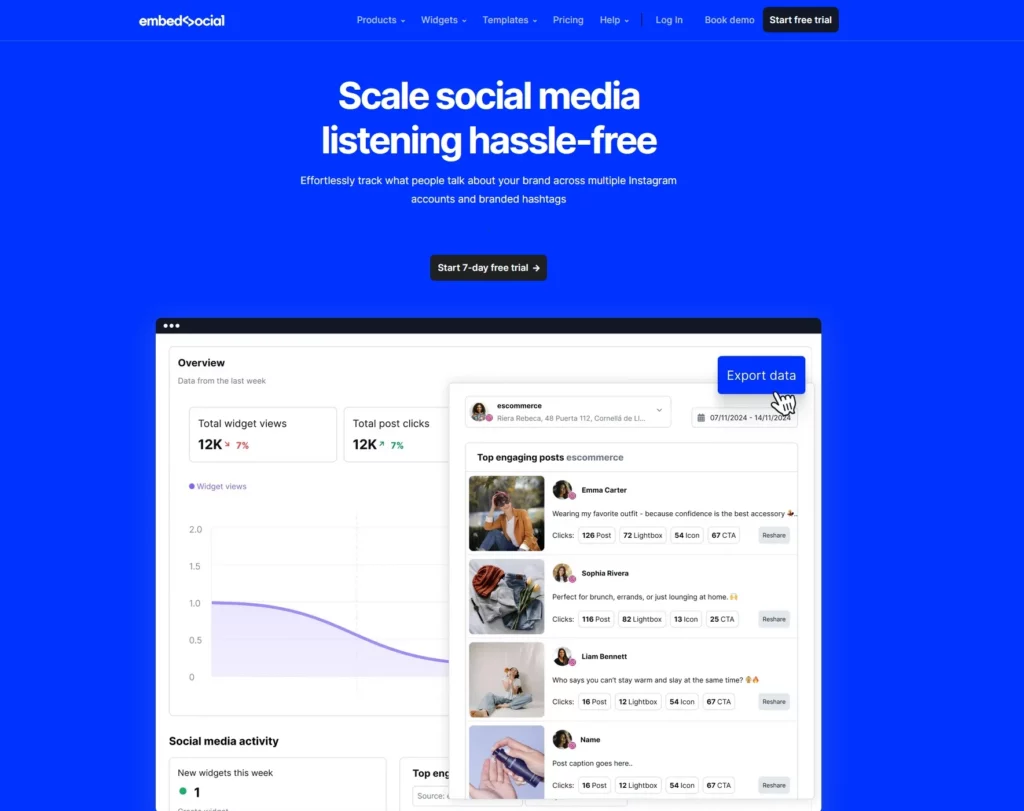
Here is what EmbedSocial helps you do:
- Track branded content across networks: collect mentions and hashtags from X, Instagram, Threads, YouTube, TikTok, and more from one dashboard.
- Monitor reviews as first-class signals: Google, Facebook, Yelp, and Trustpilot reviews live next to social mentions.
- Read AI sentiment and trends: the Trends report groups top hashtags, top authors, content types, and sentiment.
- Turn monitoring into content: any mention, hashtag post, or review can flow straight into an embeddable widget or an auto-generated social image.
- Roll data up by location: location-tagged dashboards keep multi-brand and franchise teams focused on their own store or region.
| Pros | Cons |
|---|---|
|
|
Pricing: Plans start at $29 per month with a 7-day free trial, and there is a limited free version. Enterprise and multi-location pricing is custom.
2. Brand24: Best real-time monitoring and AI sentiment for growing brands
Brand24 monitors all major social media platforms plus websites, forums, podcasts, and blogs that mention your brand, and it now tracks brand appearances inside answer engines like ChatGPT, Perplexity, and Gemini alongside classic social channels.
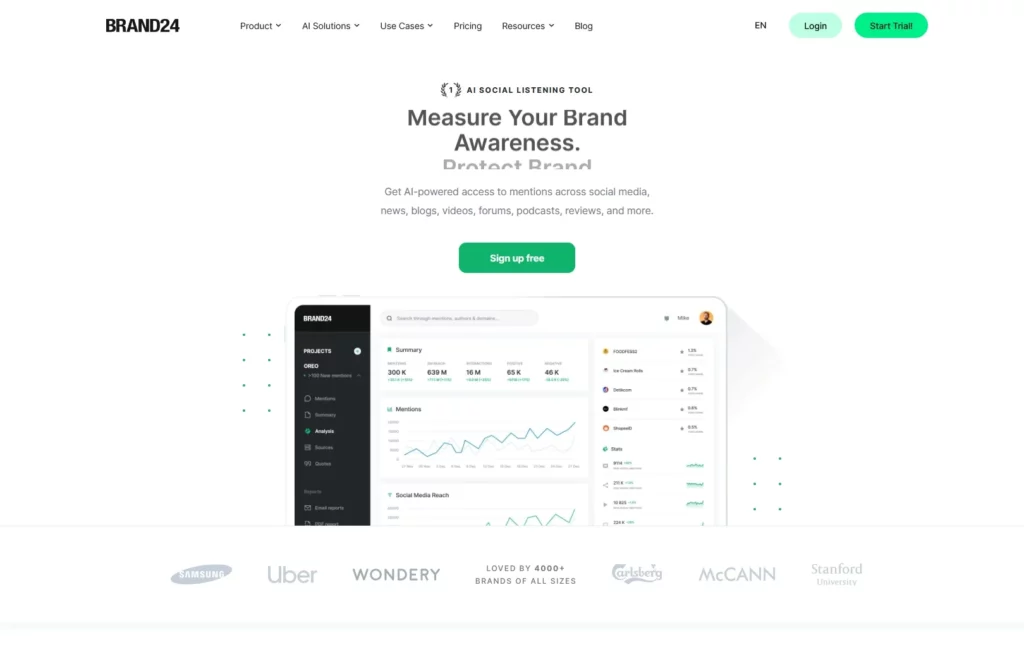
Here is what Brand24 helps you do:
- Catch mentions in near real time: live feed with instant email and Slack alerts on every plan.
- Read AI sentiment out of the box: sentiment scoring, emotions, and topic clusters ship with the Individual plan.
- Track share of voice on AI answer engines: a 2026 addition covers ChatGPT, Perplexity, and Gemini answers.
- Spot discussion spikes: the AI Brand Assistant flags anomalies and summarizes the story behind them.
- Export polished reports: PDF and CSV exports plus a public brand-mention dashboard for stakeholders.
| Pros | Cons |
|---|---|
|
|
Pricing: Pricing starts at $199 per month for the Individual plan billed annually, with a 14-day free trial and no free plan.
3. Sprout Social: Best enterprise listening bundled with publishing
Sprout Social is a social media management and analytics platform that lets you manage all of your social media accounts in one place, with monitoring built into the inbox and reporting. It supports Facebook, Instagram, X, LinkedIn, TikTok, YouTube, and Pinterest, and it is the pick for enterprise teams that want publishing and listening in one suite.
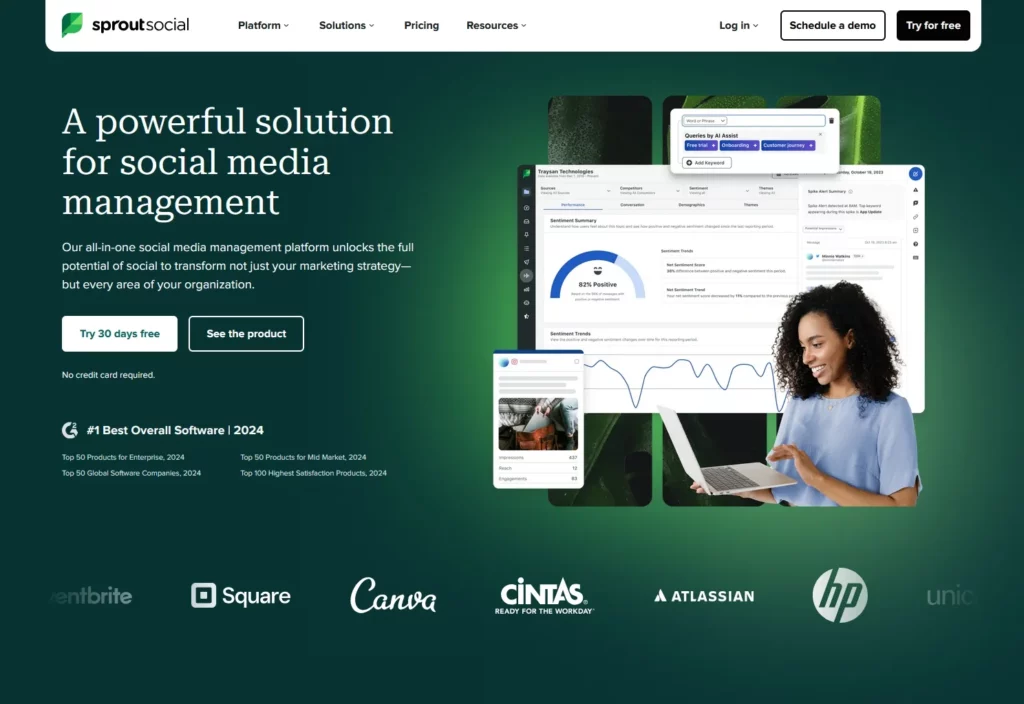
Here is what Sprout Social helps you do:
- Consolidate messages and mentions: unified Smart Inbox for DMs, comments, and brand mentions.
- Use AI to reply faster: AI Assist drafts responses, tweaks tone, and scores sentiment.
- Research your audience: built-in consumer research and audience-profile modules.
- Benchmark competitors: side-by-side share of voice and engagement reports.
- Run advanced listening: the Advanced Listening add-on unlocks Boolean queries, trend detection, and topic tuning.
| Pros | Cons |
|---|---|
|
|
Pricing: Pricing starts at $199 per seat per month billed annually, with a 30-day free trial and no free plan. Advanced Listening is quoted per customer on top of the seat price.
4. Hootsuite Listening: Best enterprise-scale listening in the Hootsuite suite
If you remember “Hootsuite Insights”, that product no longer exists. After Hootsuite acquired Talkwalker in 2024, the monitoring stack became Hootsuite Listening powered by Talkwalker. Talkwalker’s own standalone product has since been renamed Lumen by Talkwalker, but the bundled offering inside Hootsuite keeps the Hootsuite Listening name.
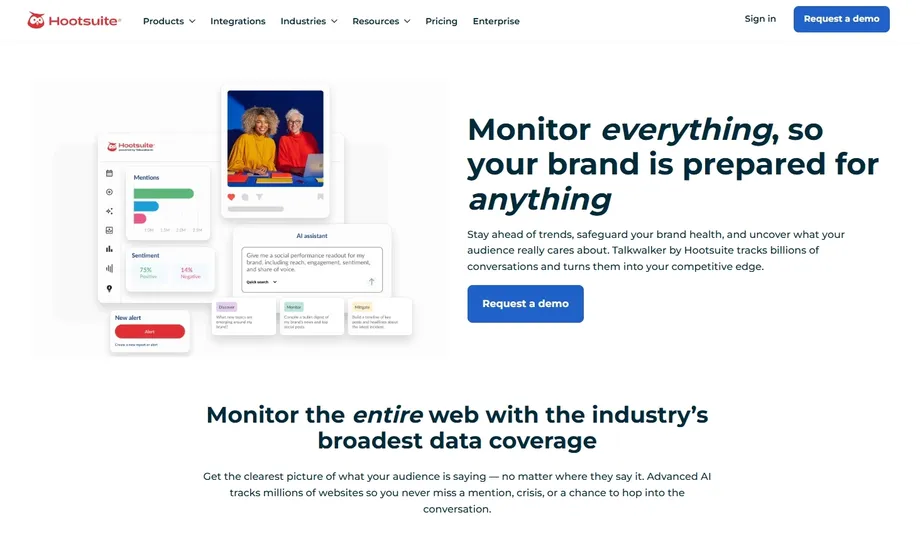
Here is what Hootsuite Listening helps you do:
- Cover 150M+ sources: the Talkwalker engine reaches social, news, blogs, forums, and reviews.
- Run visual monitoring: logo, object, and scene recognition on user-generated images.
- Get quick answers with Blue Silk AI: conversational summaries of trending topics and sentiment.
- Track share of voice against competitors: side-by-side dashboards and export-ready reports.
- Keep it tied to publishing: listening lives in the same suite as scheduling and inbox.
| Pros | Cons |
|---|---|
|
|
Pricing: Hootsuite plans start at $99 per user per month billed annually; the full Hootsuite Listening add-on is custom-priced for Enterprise and available by demo only.
5. Mention: Best mid-market brand monitoring with Boolean alerts
Mention tracks mentions of your brand or keywords across social media platforms, blogs, news websites, and forums. Mention was acquired by Agorapulse in 2025, and its publishing and engagement features were retired in January 2026, so customers now pair Mention (for alerts) with Agorapulse (for scheduling and inbox). Mention is now positioned as the monitoring and alerts specialist of the pair.
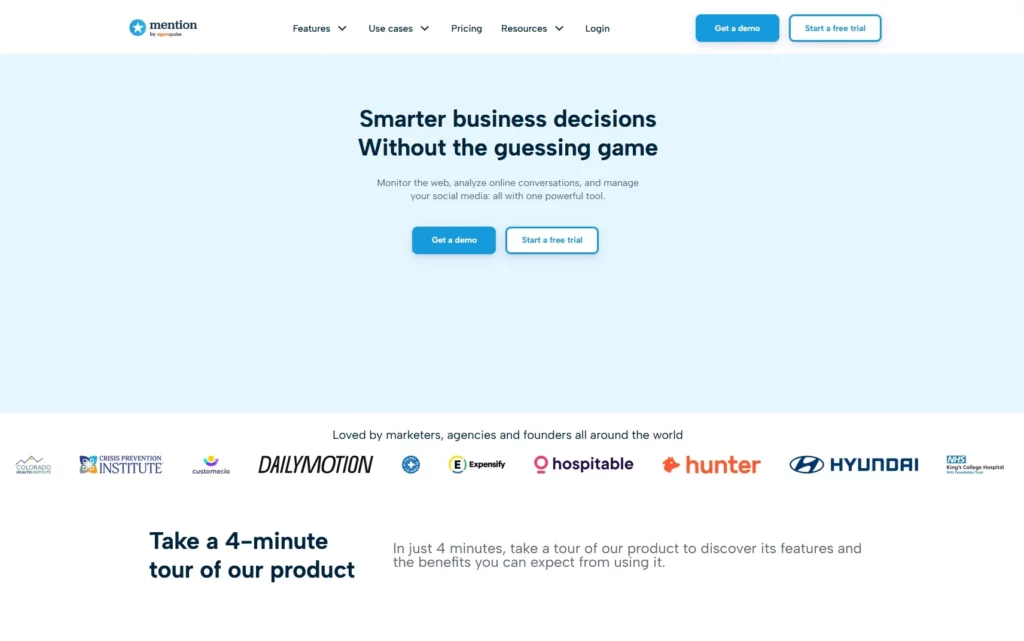
Here is what Mention helps you do:
- Set precise alerts: Boolean queries, geolocation filters, and language filters for signal-only alerts.
- Compare competitors: performance benchmarks against named rivals in the same dashboard.
- Read sentiment at scale: automatic tagging with easy manual overrides.
- Filter and export cleanly: tag-based exports feed BI dashboards and client reports.
- Cover the open web: blog, news, and forum coverage is stronger than most social-first tools.
| Pros | Cons |
|---|---|
|
|
Pricing: For new signups, pricing starts at the Company plan, $599 per month with an annual commitment, after a 14-day free trial.
6. Agorapulse: Best publishing plus lightweight listening for agencies
Agorapulse is an all-in-one social media management platform, and it is the company that now owns Mention. It bundles a unified inbox, scheduled publishing, and listening (strengthened by the Mention acquisition), which makes it a favorite for agencies that want one tool per client.

Here is what Agorapulse helps you do:
- Run a single inbox: DMs, comments, and reviews for every connected profile in one queue.
- Publish and approve at scale: shared calendars, approval workflows, and asset libraries.
- Listen alongside your inbox: brand and keyword searches feed the same dashboard as replies.
- Report on ROI: revenue tracking on paid campaigns and organic content.
- Keep small teams free: a free plan covers up to three profiles and one user.
| Pros | Cons |
|---|---|
|
|
Pricing: Paid pricing starts at $79 per user per month billed annually ($99 month to month) for 10 social profiles, with a 30-day free trial. A free plan is available.
7. Keyhole: Best for influencer and campaign analytics with historical data
Keyhole tracks hashtags, keywords, and campaigns on X, Instagram, Facebook, LinkedIn, YouTube, and TikTok. Muck Rack acquired Keyhole in 2024, and the pricing page is now co-branded, but the product still ships as a standalone analytics tool, which keeps it easy to hand off to clients.

Here is what Keyhole helps you do:
- Track hashtags and keywords over time: historical data going back years on covered platforms.
- Run campaign and event trackers: dedicated views for launches, activations, and sponsorships.
- Vet and monitor influencers: profile-level analytics, fake-follower checks, and portfolio views.
- Read sentiment and quality: post-level scoring on brand safety and engagement quality.
- Deliver client-ready reports: shareable, white-label reports on any tracker.
| Pros | Cons |
|---|---|
|
|
Pricing: Pricing starts at $179 per month for the Professional plan (3 trackers), with Corporate at $539 per month and Enterprise at $999 per month. A 14-day free trial is available; there is no free plan.
8. Awario: Best affordable Boolean-search listening for small teams
Awario tracks mentions of your brand or keywords across social media platforms, blogs, and news websites, at one of the lowest price points in this list. It is the pick when a small team wants Boolean queries and non-stop monitoring without an enterprise contract.
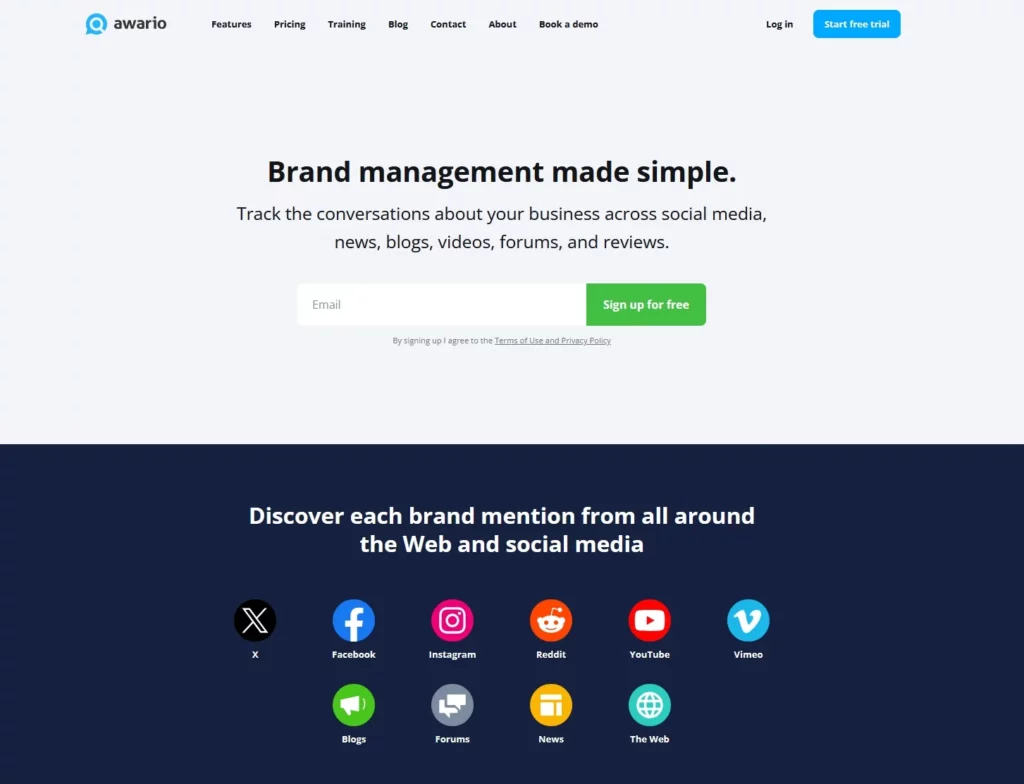
Here is what Awario helps you do:
- Run non-stop monitoring: Boolean search with mute words, source filters, and locations.
- Prioritize what matters: sentiment filters surface negative or positive mentions first.
- Sell socially: alerts on new discussions where you can pitch a product or reply.
- Track reach and influence: basic reach scoring plus influencer discovery inside the mention feed.
- Report to clients: white-label PDF reports on any topic.
| Pros | Cons |
|---|---|
|
|
Pricing: Pricing starts at $29 per month for the Starter plan billed annually ($49 per month billed monthly), with a 7-day free trial and no free plan.
9. Mentionlytics: Best multilingual listening with AI sentiment
Mentionlytics is a versatile platform with strong support for multilingual monitoring: it tracks mentions in more than 200 languages across social media, web, and review sources. That makes it a favorite for brands whose audiences live in more than one language.
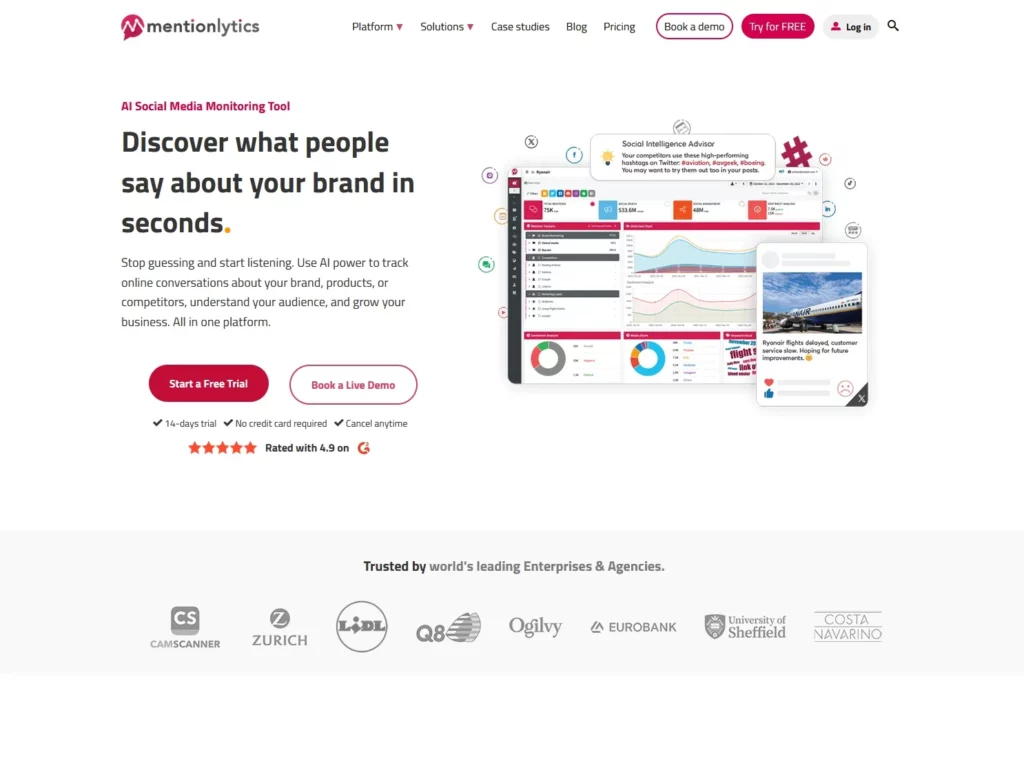
Here is what Mentionlytics helps you do:
- Monitor 200+ languages: native tokenization and sentiment on non-English mentions.
- Get plain-language recommendations: the AI advisor (“SIA”) turns your data into next steps.
- Cluster sentiment and trends: automatic grouping by topic, emotion, and platform.
- Benchmark competitors: side-by-side reports on named rivals.
- Receive smart digests: weekly and monthly summaries auto-generated per topic.
| Pros | Cons |
|---|---|
|
|
Pricing: Pricing starts at $69 per month for the Basic plan, scaling across editions up to Enterprise, with a 14-day free trial and no card required.
10. YouScan: Best visual listening for consumer brands
YouScan stands out with advanced image recognition that tracks visual mentions of your brand across the web: logos, products, and packaging appearing in user-generated photos, even when nobody writes your brand name. Insights Copilot, a ChatGPT-based assistant, is the standout AI feature on top of the visual engine.
Here is what YouScan helps you do:
- Spot logos in images: logo and scene detection on user-generated photos and video thumbnails.
- Chat with your listening data: Insights Copilot answers plain-language questions on top of any topic.
- Combine text and image signals: unified feed for what people say and what they show.
- Segment audiences: demographics, interests, and occupations extracted from social profiles.
- Detect visual context: categorize photos by scene, activity, and sentiment.
| Pros | Cons |
|---|---|
|
|
Pricing: Pricing starts at $499 per month billed annually for the Starter plan (3 topics, unlimited users), with custom unlimited tiers above it and a demo-only trial.
11. Brandwatch: Best enterprise consumer intelligence platform
Brandwatch is built for businesses that need advanced consumer intelligence and trend analysis. It uses machine learning to analyze massive volumes of online conversation and customer feedback, including one of the deepest historical X archives on the market. In 2026 the Essentials self-serve tier is gone, so Brandwatch is enterprise-only.
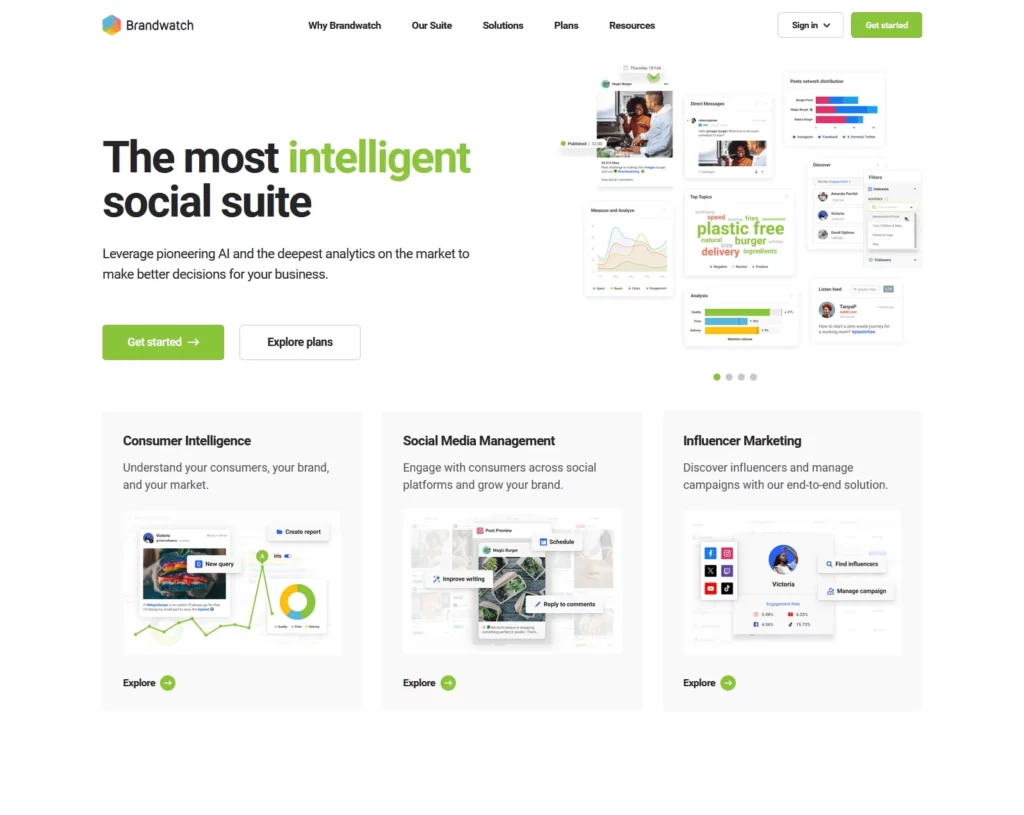
Here is what Brandwatch helps you do:
- Query the open web at scale: billions of historical posts across social, blogs, video, and forums.
- Use Iris AI: sentiment, emerging-trend detection, and topic clustering with tuned models.
- Segment audiences deeply: demographics, interests, and behavioral cohorts.
- Benchmark competitors: share-of-voice and campaign comparisons across brands.
- Feed enterprise stacks: APIs and data exports into BI, CDP, and CRM tools.
| Pros | Cons |
|---|---|
|
|
Pricing: There is no free plan or self-serve trial. Pricing is custom, quoted on request, and typically enterprise-level with an annual commitment.
How we picked the best social media monitoring tools
We chose these 11 tools by weighing what mid-market and enterprise teams actually use monitoring for in 2026:
- Coverage breadth: the tool tracks mainstream networks plus news, blogs, forums, and reviews.
- Sentiment accuracy: AI sentiment holds up on sarcasm, negations, and industry jargon.
- Alerting speed: near real-time notifications with sensible noise controls.
- Reporting and share-of-voice: dashboards and exports the marketing team will actually open.
- Pricing transparency: clear entry tier, no surprise seat fees on the plan we recommend.
Why social media monitoring matters
Monitoring turns unstructured social chatter into signals your team can act on. Here is what a good monitoring setup delivers day to day:
- Real-time alerts on brand mentions across networks
- Sentiment shifts that flag reputation risks early
- Competitor moves you can respond to before they set the narrative
- Voice-of-customer patterns that guide product and support decisions
- Influencer and advocate discovery
- Campaign and share-of-voice measurement
- Crisis triage with full context
Skip monitoring and you are letting others define the conversation about your brand.
How to get started with social media monitoring
The process can be simple as long as you follow these few steps. Consider them a blueprint for whenever you start a new monitoring quest.
Step 1: Decide what you need
When you identify your goals, it will be easier to set the tool for specific searches.
Are you looking to improve your marketing efforts? Gauge customer sentiment? Monitor your competition? Identify potential leads? Each goal may require different tools and tactics.
Here are some of the things you should consider when configuring the settings:
- The name of the company or brand being monitored
- The social media sites to be monitored
- The language of the social media sites
- The type of monitoring (real-time or historical)
- The time period for monitoring
Step 2: Choose the most relevant keywords and hashtags
Keywords and hashtags are important for social media monitoring because they help you track the conversations that are relevant to your business.
You’ll want to track both general keywords and those specific to your industry. Our guide to social listening keywords walks through how to build that list.
Step 3: Optimize the search results
There is a lot of noise out there, and sometimes even the relevant keywords and hashtags might not be enough.
So, make sure you refine those search results to weed out spam or unrelated posts, and focus on identifying trends and categorizing relevant results.
Step 4: Analyze and create your strategy accordingly
Not all social media channels are created equal. Some are more popular with certain demographics than others.
You’ll want to track the social media trends and channels that your customers are most active on and shift your focus over there.
Sometimes, your social media monitoring report might show negative feedback from your customers. Should this happen, you can use this data to improve anything that might have caused this negative trend. The point is to use the information to adjust and adapt.
Step 5: Set up your social media monitoring tool
Once you’ve defined your strategy, the hashtags, and the goals of your social media monitoring strategy, the last thing you need is to set up a social media monitoring tool that will help you aggregate the content and get the data you need to do your social media analysis.
Below, I show you how to aggregate all your UGC posts from specific sources and collect them into one platform for further analysis.
Before you start, however, you have to create a free trial account to get this functionality.
Step 1: After logging in, connect all your social media sources under ‘Sources’.
Step 2: Next, download the data needed for the social media analysis under ‘Reports’.
Step 3: Upload the file to get the analysis numbers and charts under ‘Trends’.
That’s all you had to do! Once you are done, you’ll get all this data structured concisely:
- Total posts
- Unique authors
- Date range for the posts analysed
- 10 most popular hashtags
- Top 10 authors
- Content by type: video, image, carousel, text
- Content by platform
- Most used keywords
- Sentiment analysis
- Post timeline

Key takeaways
As AI answers and social conversations shape buying decisions, it is becoming increasingly important for businesses to be aware of what is being said about them online.
Aside from the potential for dealing with and learning from negative publicity, social media monitoring can also provide valuable insights into customers’ needs and preferences.
Quick recap of where each tool fits in 2026:
- Best all-in-one for multi-location brands: EmbedSocial.
- Best AI analytics mid-market: Brand24 or Mentionlytics.
- Best all-in-one management suites: Sprout Social, Agorapulse, Hootsuite Listening.
- Best specialist tools: Keyhole (influencers and campaigns), YouScan (visual), Mention (Boolean alerts), Awario (budget Boolean).
- Best enterprise research: Brandwatch.
If you also need to track mentions outside social networks, in news, blogs, review sites, and AI chatbots, pair this list with our brand monitoring tools comparison.



![12 Best Twitter (X) Monitoring Tools in 2026 [Compared]](https://embedsocial.com/images/blog/twitter-monitoring-tools/featured.avif)


