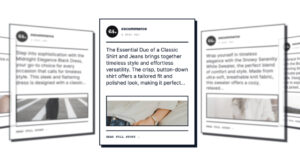
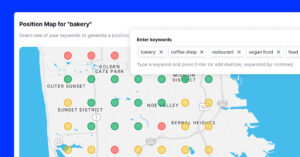
Marketers today are able to access a treasure trove of authentic customer photos, videos, and reviews, and yet most of it goes unseen due to a lack of time and tools.
Thankfully, AI has stepped in, not to replace human creativity, but to help brands discover, analyze, and amplify the voices and content of their customers.
Want to know how UGC and AI mix to convert leads?
I’ll show you how these AI-powered tools are transforming user-generated content (UGC) into a measurable growth engine. Keep reading below!
Why does human-generated content still drive the strongest trust?
People trust people, even in this age of algorithms and AI.
According to a recent EnTribe survey, 82% of respondents said they would be more inclined to purchase products from brands that utilize UGC in their campaigns.
This percentage reveals one truth: authenticity converts!
UGC, including customer reviews, selfies, videos, photos, product demos, etc., acts as modern word-of-mouth since it’s raw, emotional, and real.
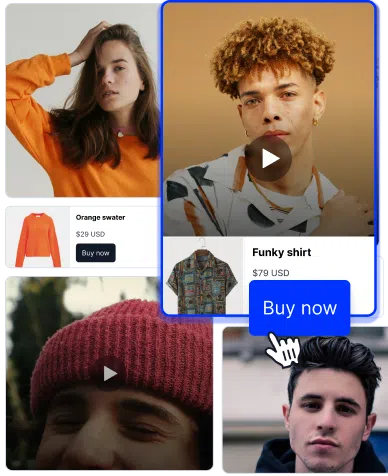
Plus, you can make this content shoppable, i.e., when embedded, you can add links to your products and services to it to streamline the sales process.
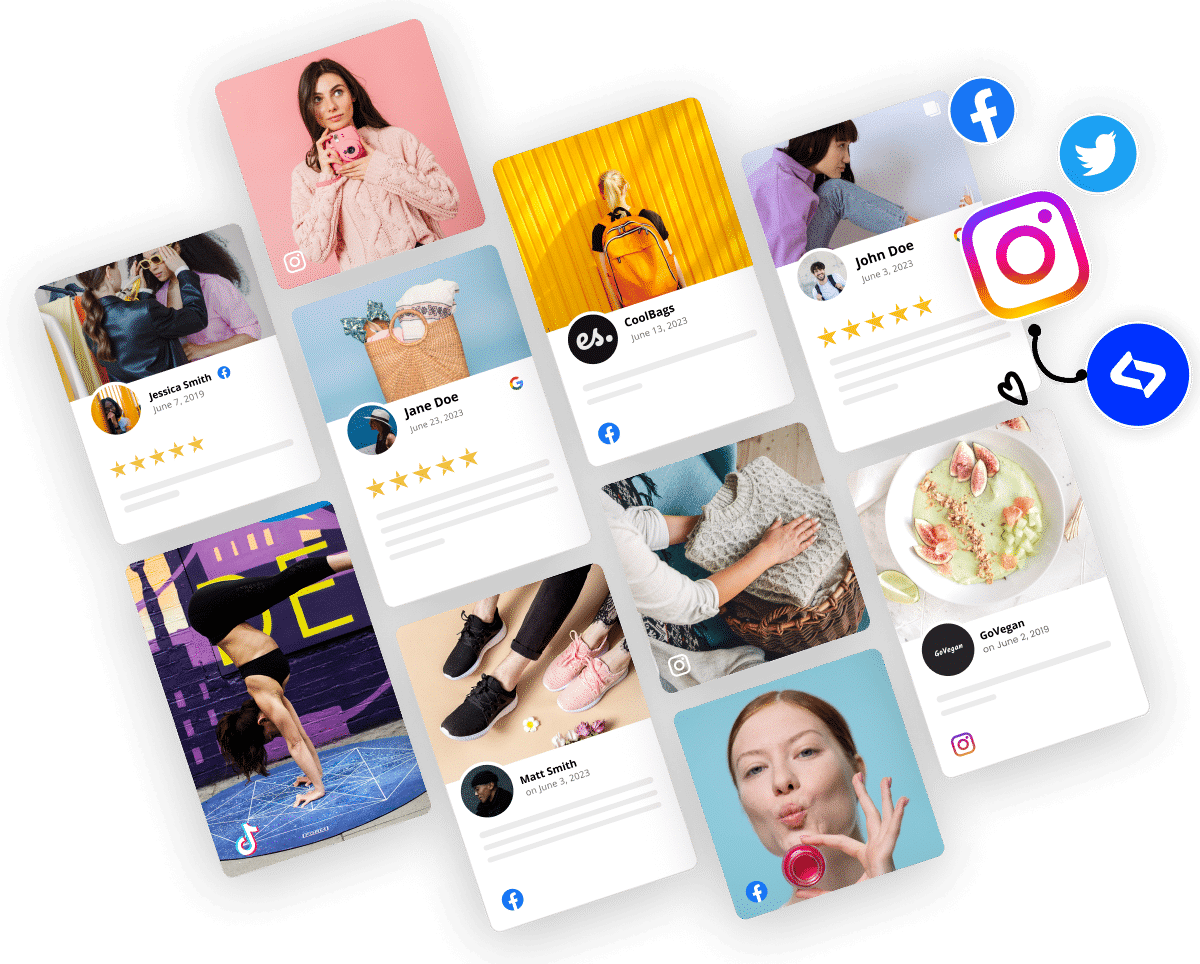
Here’s how all this content could look when embedded on your website:
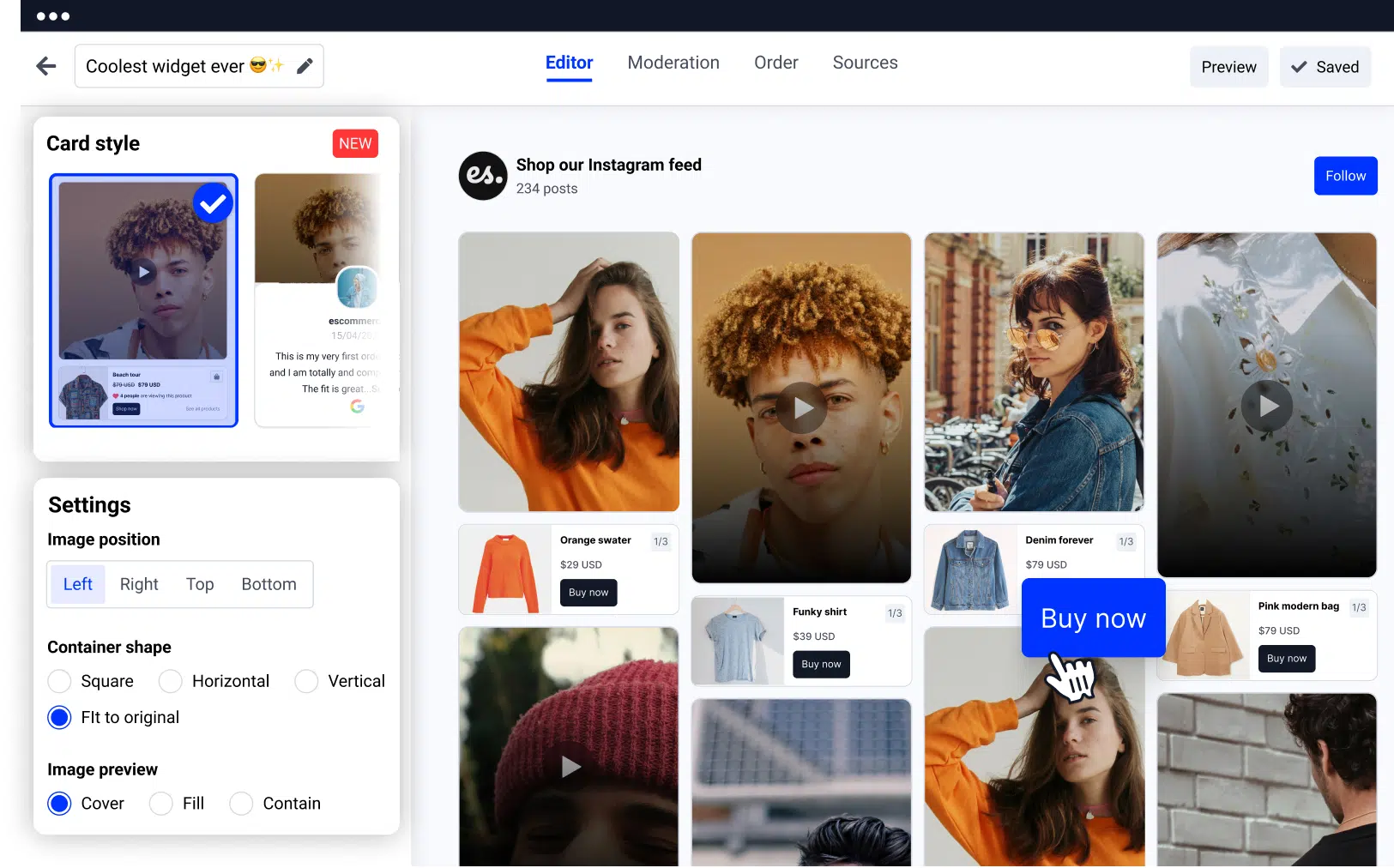
Remember: I am not suggesting AI replace this human touch, but in fact, strengthen it by making sure the right stories reach the right audiences faster.
So, when it comes to serving content, you shouldn’t be using an AI video generator to create video ads, for example, since AI UGC videos are not trustworthy.
In short: human trust + AI delivery = modern conversion power.
How is AI transforming user-generated content marketing?
AI has quietly become the secret weapon when it comes to creating the perfect UGC marketing strategy, as it helps you maximize your content’s potential.
Now, instead of scrolling through thousands of tagged posts, brands can rely on AI tools to detect, categorize, and evaluate UGC automatically.
Here’s what that looks like in practice:
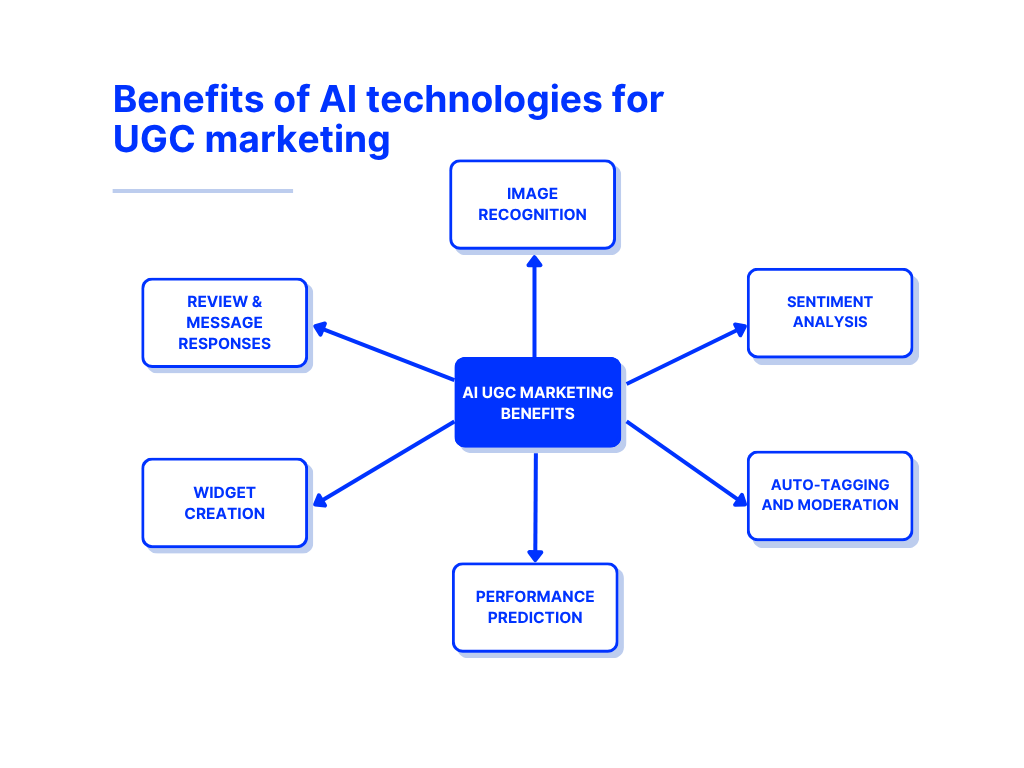
- Image recognition—AI can correctly identify brand logos, products, and scenes across user-generated photos;
- Sentiment analysis—gauge whether posts carry positive, neutral, or negative emotions, and then summarize the overall brand sentiment;
- Auto-tagging and moderation—AI filters all the content you collect and organizes it based on pre-set rules and themes;
- Performance prediction—AI UGC tools analyze which visuals are likely to drive engagement or sales for your brand, so you can use them in your campaigns;
- Widget creation—user-generated content platforms with AI can create the perfect embeddable widgets based on user prompts;
- Review & message responses—quickly and easily respond to customer feedback and inquiries on Google and popular social media platforms.
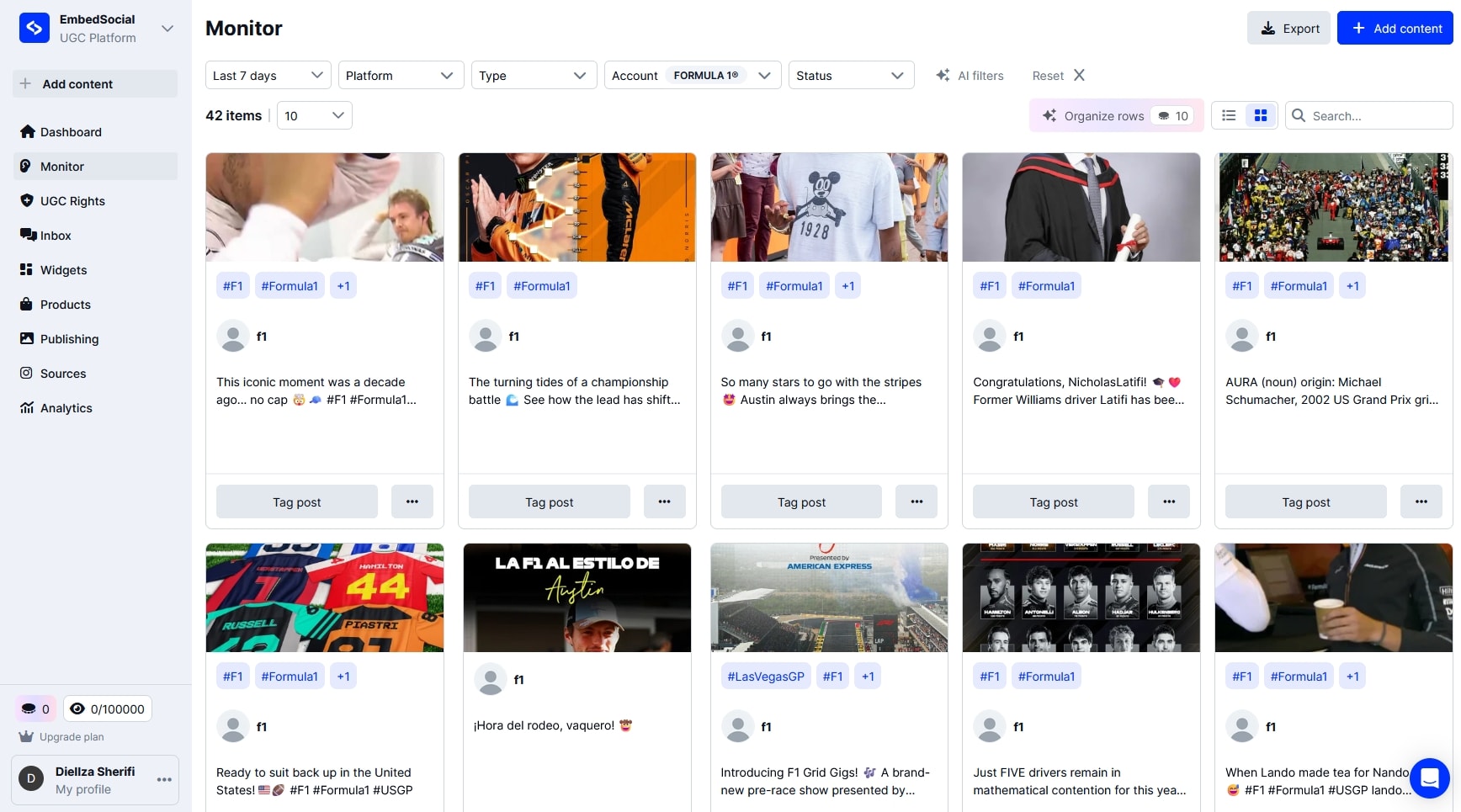
Several UGC platforms like EmbedSocial already use these techniques to help marketers uncover and showcase their most impactful customer stories from a single dashboard.
The goal is simple: spend less time managing content and more time amplifying it.
Here’s a handy table outlining the impact of AI on the UGC marketing pipeline, and as you can see, it doesn’t replace human creativity, but maximizes it!
| UGC Stage | Traditional Approach | AI-Powered Approach | Conversion Impact |
|---|---|---|---|
| Curation | Manual collection and filtering | Automated discovery and quality scoring | Saves time, improves content quality |
| Analysis | Limited performance tracking | AI predicts top-performing visuals | Boosts engagement rates |
| Distribution | Same content for all users | Personalized social proof per audience | Increases relevance and conversions |
| Optimisation | Trial and error | Data-backed timing and placement | Maximizes ROI |
How to get started with user-generated content AI tools
If you’re ready to make AI part of your UGC workflow, start small and only scale up once you get the hang of the process and assure yourself that it’s worth it!
Here’s a simple roadmap you can follow:
- Audit your UGC sources like Instagram, TikTok, Google, and customer reviews;
- Pick an AI tool for curation or analytics;
- Train the algorithm by feeding it existing UGC data;
- Test one campaign first and measure what content performs best;
- Scale across more channels once you see results.
Here’s a sample user interface of a UGC platform showcasing all it can do:
6 best practices for using AI-powered UGC to increase conversions
The most forward-thinking brands are using AI to turn everyday customer content into measurable business growth. Here’s how to do it intelligently:
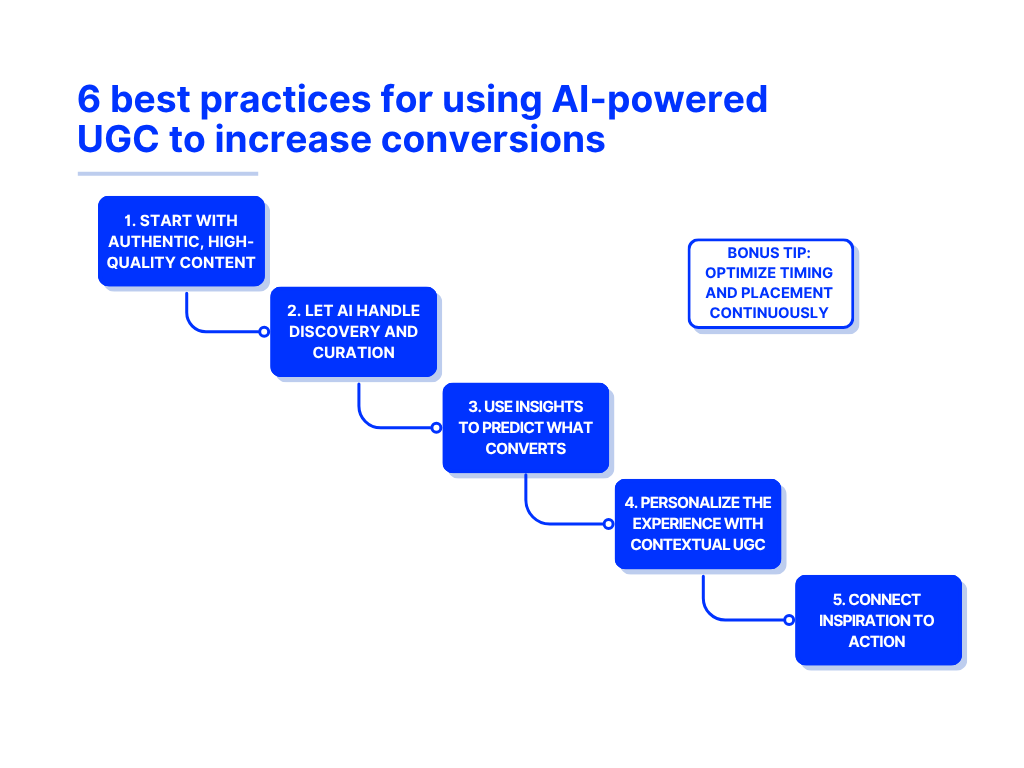
1. Start with authentic, high-quality content
Every successful AI strategy begins with genuine human stories.
AI tools rely on authentic data to deliver accurate insights, so your foundation must be real customer photos, videos, and reviews—never fabricated material. Curate UGC from verified customers, secure usage rights, and keep brand alignment consistent.
Once you’ve done that, AI can analyse quality, spot emerging trends, and surface the most persuasive visuals while preserving the UGC authenticity.
💡 Pro tip: Feed your AI system with diverse UGC sources (Instagram, TikTok, Google Reviews, and more). The broader your dataset, the smarter your AI becomes at identifying content that resonates.
2. Let AI handle discovery and curation
Finding on-brand UGC used to mean hours of manual scrolling. Now, AI can detect mentions of your brand across platforms, analyse tone and composition, and instantly surface the best-performing content, which you can immediately use in your campaigns.
This automation allows marketing teams to move from reactive discovery to proactive storytelling since they will be easily curating UGC that matches their brand identity while freeing up creative time for strategy and campaign design.
💡 Pro tip: Use keyword and sentiment filters to train your AI to spot not just positive content but emotionally compelling stories. Emotionally charged UGC performs 2–3× better in engagement tests.
3. Use insights to predict what converts
AI goes beyond counting likes, as it can be trained to understand patterns. By analysing variables like lighting, background, product placement, and caption tone, AI can predict which visuals drive clicks and purchases for your brand.
So, instead of simply republishing user posts, you can prioritise those most likely to convert based on historical performance and predictive analytics.
💡 Pro tip: Pair AI-driven insights with A/B testing. Let your algorithm highlight likely winners, then validate them in real-world campaigns. The feedback loop will make both your AI and your marketing sharper over time.
4. Personalize the experience with contextual UGC
Since relevance builds trust, brands are looking to AI to make it scalable.
AI-powered recommendation engines can dynamically adjust the UGC shown to each visitor, presenting reviews from local shoppers, images that match browsing history, or content aligned with their intent.
This hyper-personalisation ensures every user sees proof that feels tailor-made, bridging the gap between emotional resonance and conversion.
💡 Pro tip: Use AI to cluster audiences by behaviour rather than demographics. You’ll uncover micro-segments, like repeat purchasers or cart abandoners, that respond to different forms of social proof.
5. Connect inspiration to action
Once AI has identified your best-performing UGC, connect it directly to your sales funnel.
By using object recognition and visual tagging, AI can automatically detect products in photos or videos and link them to the corresponding product page. This transforms your UGC galleries into shoppable experiences that turn browsers into buyers.
💡 Pro tip: Track clicks and conversions from shoppable UGC separately. This data will show which types of social proof drive not just engagement, but actual revenue.
Bonus tip: Optimize timing and placement continuously
Even the best UGC underperforms if shown at the wrong time or place.
AI learns from publishing data to determine which platforms, time zones, and content formats yield the highest engagement. It can even suggest the ideal cadence for refreshing creative assets to avoid fatigue.
This constant refinement creates a virtuous cycle that enhances your campaigns.
💡 Pro tip: Feed your AI not just social metrics but also conversion data. When timing and platform decisions are based on sales outcomes rather than impressions, ROI grows exponentially.
The takeaway?
While not the author of your brand story, AI can serve as the editor, strategist, and data analyst, helping your audience see the right stories at the right time.
So, follow these best practices, and you’ll transform customer voices into an always-on engine for trust, engagement, and conversions.
Real-world examples of AI-powered UGC success
AI is the silent engine behind how top brands deal with managing and amplifying user-generated content at scale. Here are a few real-world cases proving its impact.
L’Oréal Professionnel Paris: AI-powered curation boosts engagement
In the DACH region, L’Oréal Professionnel Paris partnered with the AI-driven content platform StoryStream to automate the discovery, curation, and rights management of UGC.
The results were striking: Instagram posts featuring user-generated visuals achieved 41% higher engagement rates compared to standard branded posts.
By letting AI surface and categorise their most inspiring customer content, L’Oréal amplified authentic storytelling and turned UGC into a measurable engagement driver.
L’Oréal Group: Predicting trends through AI and social listening
Beyond curation, the broader L’Oréal Group built TrendSpotter, an AI system that analyses data from over 3,500 digital sources, including social posts, reviews, and videos, to predict beauty trends before they go mainstream.
This is a genuine and real-world application that shows how AI can transform organic UGC into predictive intelligence, helping brands align their campaigns with what customers genuinely care about.
L’Oréal claims that it can accurately predict trends on a 6 to 18-month time horizon, in the main beauty categories: skincare, haircare, and makeup!
Nike: Sentiment analysis for smarter content strategy
Nike applied natural language processing and sentiment analysis to its vast database of customer feedback and online reviews.
Partnering with OnBeat Digital, the company transformed unstructured customer data into actionable insights that influenced both marketing campaigns and product development.
While not a direct UGC-to-sale pipeline, this shows how AI helps brands interpret the emotional tone of user-generated text, thus enabling smarter, more customer-informed creative decisions.
Academic insight: AI-enhanced presentation of UGC increases engagement
A recent study on arXiv demonstrated how applying AI to UGC videos by generating more relevant titles resulted in 7.1% more valid views and 4.1% longer watch times.
Though experimental, it reinforces the same principle: AI doesn’t need to create content to make it more effective, as it can make authentic material perform better.
Together, these cases highlight the same truth: AI doesn’t replace human creativity, but scales it. From beauty to sportswear to academic research, data-driven curation and analysis are helping brands unlock more value from the content of their communities.
Conclusion: Combine human authenticity with AI precision!
AI won’t make UGC more human, and brands shouldn’t even attempt it, but it can be a very powerful tool for maximizing the potential of this type of content.
So, instead of relying on an AI UGC video generator to create UGC ads and lifelike AI avatars, you should be pairing authentic customer voices with machine precision. Brands can showcase trust at scale and convert browsers into believers.
That way, you offload the costly content creation tasks to your followers, and you get much more, better, and trustworthy content for little to no cost.
In 2025 and beyond, the winners will be the marketers who blend empathy with intelligence in their AD campaigns, i.e., the human touch amplified by smart technology.
AI content marketing is the new norm, and brands need to get on board yesterday! Content product and marketing videos created via social media posts—the cheapest and best way to produce high-quality content for your target audience.
FAQs about UGC AI tools
What is user-generated content in marketing?
UGC (user-generated content) includes photos, videos, reviews, and other similar content created by customers that brands can share to build trust and authenticity.
How does AI help with UGC?
AI tools automate curation, tagging, and performance analysis, so marketers can quickly find and use the best-performing customer content.
Can AI tools find and analyse UGC automatically?
Yes. AI can scan platforms like Instagram, TikTok, Facebook, and more, for brand mentions, detect logos, and evaluate sentiment.
How does UGC increase conversions?
Ultimately, potential customers require the social proof that UGC inherently contains, as they need to trust the brand before they convert to followers.
Are AI UGC tools suitable for small businesses?
Absolutely. Modern platforms are scalable, affordable, and easy to use, even for small teams without any technical or coding knowledge.