

The best social media management tools in 2026 are Sprout Social for mid-size teams, Buffer for solo creators, SocialPilot for agencies, and Hootsuite for enterprise teams that need listening. If you only have 30 seconds, the quick picker below tells you which one fits you.
Most “best tools” lists are written by a vendor that ranks itself first. We left EmbedSocial out of the ranking, because our core product is not a scheduler. It is the piece these tools leave out, and we cover it in its own section after the list.
Disclosure: this post is written by EmbedSocial’s CEO. EmbedSocial is not ranked. All prices were checked on each vendor’s pricing page on September 23, 2026, in USD, billed monthly unless noted.
What are social media management tools?
Definition: Social media management tools are platforms that help businesses plan, publish, engage with and measure content across multiple social networks from one place. Many add social listening, review collection, team collaboration and reporting on top.
At a minimum, a modern social media management tool covers four jobs: publishing with a calendar and scheduler, a unified inbox for messages and comments, analytics for reach and engagement, and account management for teams.
Higher tiers layer in social listening tools, competitor benchmarking, approval workflows, AI caption drafting, and integrations with reviews, ads and CRM systems. This is where social media management tools start to differ most, in features and in price.
If you only need the automation side (scheduling, recycling and cross-posting), see our list of social media automation tools. For the design and video side, our social media content creation tools roundup covers creator workflows.
Quick picker: the best social media management tool for your situation
| If you are… | Pick | Why |
|---|---|---|
| A solo creator or freelancer | Buffer | Pay per channel, from $5/mo, with a usable free plan |
| A small business with 1 to 3 people | Metricool | Strong analytics from $20/mo, free plan for one brand |
| An agency with many clients | SocialPilot | 15 accounts and 3 users for $50/mo, white label from $100 |
| A brand living on Instagram and TikTok | Later | Visual planner built for Reels and TikTok |
| A mid-size in-house team | Sprout Social | Best mix of inbox, publishing and reporting |
| An enterprise that needs listening | Hootsuite | Unlimited accounts and listening on higher tiers |
Social media management tools compared
The column most lists skip is the last one. How a tool charges matters more than its starting price, because it decides what happens to your bill when the team grows.
| Tool | Best for | Starting price | Free plan | Pricing model |
|---|---|---|---|---|
| Sprout Social | Mid-size teams | $99/seat/mo | No (30-day trial) | Per user |
| Hootsuite | Enterprise listening | $99/user/mo | No (14-day trial) | Per user |
| Buffer | Solo creators | $5/channel/mo | Yes, 3 channels | Per channel |
| Metricool | Analytics on a budget | $20/mo | Yes, 1 brand | Per brand tier |
| Vista Social | Small teams wanting it all | $79/mo | No (14-day trial) | Flat tier |
| Agorapulse | Inbox and engagement | $99/user/mo | Limited | Per user |
| Sendible | Client reporting | $29/mo | No (14-day trial) | Flat tier, unlimited users |
| Later | Instagram and TikTok | $18.75/mo (annual) | No (14-day trial) | Flat tier |
| SocialPilot | Agencies | $30/mo | No (14-day trial) | Flat tier |
| Zoho Social | Zoho users | Free, paid tiers vary | Yes, 1 brand | Flat tier |
The 10 best social media management tools in 2026
Every tool below follows the same format, so you can compare them side by side: who it’s for, what it costs, what it does best, where it falls short, and when to skip it.
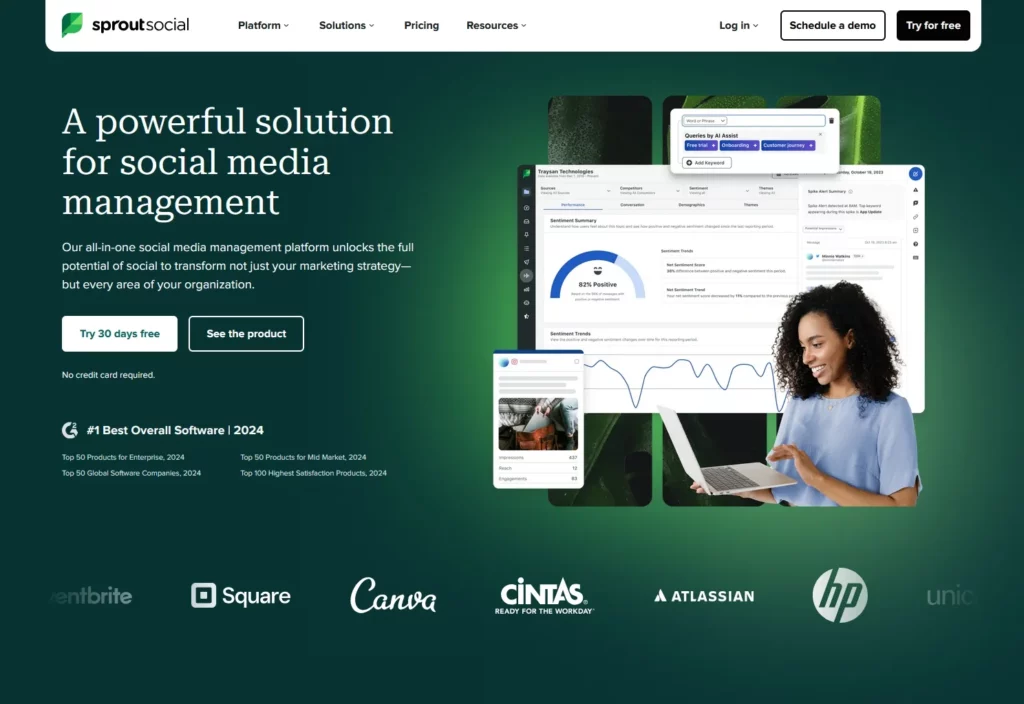
1. Sprout Social: best overall for mid-size marketing teams
Best for: in-house teams of 3 to 20 people who need publishing, a shared inbox and reporting in one place.
Starting price: $99/seat/mo on Essentials ($79 billed annually), 5 profiles. Standard is $199/seat.
Key features:
- Smart Inbox that pulls comments, DMs and mentions from every network into one feed
- Publishing calendar with suggested best times to post
- Presentation-ready reports on performance and team response times
- Approval workflows and task assignment for teams
- Social listening and employee advocacy as add-ons
Sprout’s strength is polish. The unified inbox, publishing calendar and reports all feel like one product, not three tools stitched together. Its reports are clean enough to send to leadership without rebuilding them in slides.
Where it falls short: the per-seat model gets expensive fast. Five profiles on the lower tiers is tight for any brand with regional accounts.
Skip it if: you’re a team of one, or you need more than five profiles on a small budget.
2. Hootsuite: best for large teams that need social listening
Best for: enterprise and large marketing teams that monitor brand mentions across many accounts.
Starting price: $99/user/mo on Standard (10 accounts). Professional is $199/user/mo with unlimited accounts.

Key features:
- Scheduling and bulk publishing across the major networks
- Social listening and brand monitoring
- Shared inbox for messages and comments
- Custom analytics reports
- Unlimited social accounts from the Professional plan up
Hootsuite is the oldest name on this list and still one of the broadest. Listening, publishing, inbox and analytics sit under one login, and the higher tiers remove the account cap entirely.
Where it falls short: the interface carries years of added features, so onboarding takes longer. There’s no free plan, only a 14-day trial.
Skip it if: you mainly need scheduling. You’d be paying for a lot you won’t touch.
3. Buffer: best for solo creators and tight budgets
Best for: creators, freelancers and small businesses who want simple scheduling without a contract.
Starting price: free for 3 channels (10 scheduled posts each). Essentials is $5/channel/mo; Team is $10/channel/mo with unlimited users.

Key features:
- Per-channel posting queue with first-comment scheduling
- AI Assistant for drafting and repurposing posts
- Community inbox, even on the free plan
- Hashtag manager and advanced analytics on Essentials
- Approval workflows, custom permissions and branded reports on Team
Buffer does one thing extremely well: getting posts out on time with almost no learning curve. Per-channel pricing means you pay only for the accounts you use, and the free plan is good enough to run a small brand.
Where it falls short: the inbox and analytics are basic next to Sprout or Agorapulse. Costs rise in a straight line as you add channels.
Skip it if: you manage 20+ channels, where a flat-tier tool becomes cheaper.
4. Metricool: best value for analytics and ads reporting
Best for: small businesses and marketers who care about numbers as much as scheduling.
Starting price: free for 1 brand (20 posts/mo). Starter from $20/mo for 5 brands; Advanced from $53/mo adds team members and approvals.

Key features:
- One dashboard for organic, competitor and ads analytics
- Planner for scheduling across networks
- Downloadable PDF and PPT reports
- Competitor tracking (100 analyses on Starter)
- Team management, approvals, API and Looker Studio connector on Advanced
Metricool punches well above its price. You get organic analytics, competitor tracking and ad reporting in one dashboard, plus a Looker Studio connector on Advanced. For most small teams, it replaces a separate reporting tool.
Where it falls short: the free plan excludes LinkedIn and X. Team features only unlock on Advanced.
Skip it if: you need a heavy-duty shared inbox for customer service.
5. Vista Social: best all-in-one for small teams
Best for: small teams and lean agencies that want enterprise features without enterprise pricing.
Starting price: $79/mo on Professional (15 profiles, 2 users). Advanced is $149/mo (30 profiles, 4 users).

Key features:
- Publishing to 13+ networks on every plan
- Unified inbox for comments and messages
- Built-in reporting
- Monthly AI credits for writing posts (1,000 on Professional)
- Optional add-ons for listening and employee advocacy
Vista Social supports 13+ networks on every plan and bundles publishing, inbox, reporting and AI credits into flat tiers. That makes budgeting simple: you know the bill before you add a teammate.
Where it falls short: listening, employee advocacy and even X are paid add-ons. There’s no free plan.
Skip it if: X is your main channel and you don’t want another add-on line on the invoice.
6. Agorapulse: best for unified inbox and community management
Best for: brands with high comment and DM volume that treat social as a customer service channel.
Starting price: $99/user/mo on Standard ($79 billed annually), 10 profiles. Professional is $149/user/mo.

Key features:
- Unified inbox with assignment, tagging and a clear-it-like-email workflow
- Publishing to 11 networks, including Bluesky, Reddit and Google Business Profile
- Social listening for brand mentions
- Performance reports for teams and clients
- 30-day trial with all networks included
Agorapulse built its name on the inbox, and it’s still the strongest on this list for it. Comments, DMs and mentions land in one queue you can assign, tag and clear like email. It supports 11 networks, including Bluesky and Reddit.
Where it falls short: per-user pricing hurts once the whole support team needs access. Profile limits apply per plan.
Skip it if: your social is mostly broadcast with little conversation.
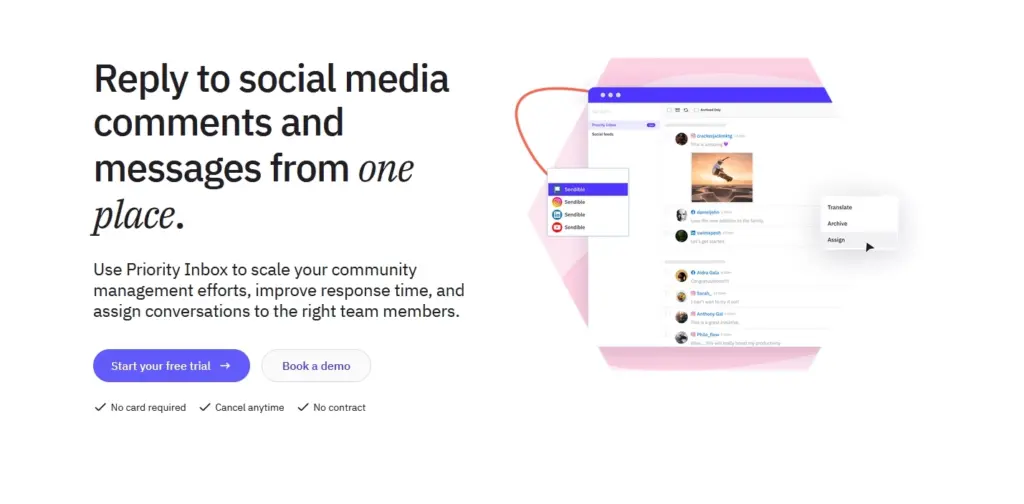
7. Sendible: best for agencies that need client reporting
Best for: agencies and consultants who report to clients every month.
Starting price: $29/mo on Core (6 profiles, unlimited users). Plus is $99/mo for 18 profiles.
Key features:
- Unlimited users on every plan
- Separate workspaces for each client
- Branded client reports
- Content calendar and scheduling
- White label as an add-on from the Elite plan
Sendible’s standout is that every plan includes unlimited users, which is rare. Workspaces keep each client separate, and branded reports are built for sending straight to clients.
Where it falls short: white label is a paid add-on, and only from the Elite plan ($399/mo) up.
Skip it if: you need white label on a small budget. SocialPilot gets you there cheaper.
8. Later: best for Instagram and TikTok visual planning
Best for: content-heavy brands and creators whose results come from Instagram, TikTok and Pinterest.
Starting price: $18.75/mo billed annually for 1 social set (8 profiles, 1 user). Growth is $37.50/mo billed annually.

Key features:
- Visual grid planner to preview your feed before posting
- Scheduling for Instagram, TikTok, Facebook, Threads, Pinterest, LinkedIn, YouTube and Snapchat
- Social sets of 8 profiles each
- Performance analytics
- Add-on social sets and users on higher plans
Later started as an Instagram planner, and the visual grid preview is still the best way to plan a feed before it goes live. It now covers eight platforms, including TikTok, Threads, YouTube and Snapchat.
Where it falls short: Starter caps you at 30 posts per profile per month. No free plan.
Skip it if: LinkedIn and X are your main channels.
9. SocialPilot: best affordable tool for agencies managing many clients
Best for: agencies and freelancers managing several client brands.
Starting price: $30/mo on Essentials (7 accounts, 1 user). Standard is $50/mo for 15 accounts and 3 users; Premium ($100/mo) adds white label and unlimited client seats.

Key features:
- Scheduling for 7 to 50 accounts depending on plan
- Social inbox, analytics and team collaboration from Standard
- Client management with unlimited client seats on Premium
- White label on Premium and above
- Monthly AI credits for content (500 on Essentials)
SocialPilot is the value pick for agencies. White label from $100/mo is the cheapest on this list, and client seats let clients review and approve posts without you paying for another user.
Where it falls short: analytics are lighter than Sprout or Metricool. Support runs 24/5, not 24/7.
Skip it if: you’re one brand with deep reporting needs.
10. Zoho Social: best for small businesses already on Zoho
Best for: businesses already running Zoho CRM or Zoho Desk.
Starting price: a free plan (1 brand, 6 channels, 1 user). Paid plans add channels, monitoring and approvals, with 33% off yearly.

Key features:
- Publishing calendar with SmartQ best-time suggestions
- Monitoring dashboard and livestream
- RSS feeds and bulk scheduling
- Inbox and content approvals on Premium
- Native Zoho CRM and Zoho Desk integration
Zoho Social’s edge is the connection to Zoho CRM and Desk, so a comment can turn into a lead or a ticket without copy-pasting. Agency plans cover 10 or 20 clients.
Where it falls short: team members are capped low on most plans. Outside the Zoho ecosystem, it has fewer reasons to win.
Skip it if: you don’t use any other Zoho product.
What social media management tools don’t do: put your social content to work on your website
Every tool above does the same core job: it pushes content out to social networks. Then your best posts, customer photos and reviews scroll away in a feed within days.
None of the 10 tools display that content where buyers make decisions: your homepage, product pages, landing pages or in-store screens. That’s the gap EmbedSocial fills.
EmbedSocial is a social media aggregator, not a scheduler. It pulls content from Instagram, TikTok, Facebook, YouTube, X, LinkedIn, Threads, Pinterest, Google Reviews, Trustpilot and Yelp into one place, then turns it into widgets for your site.

- Embeddable feeds and sections: social walls, carousels, shoppable galleries, testimonial and floating widgets, from 200+ templates
- Moderation: handpick posts or filter by keyword and date
- AI Widget Builder: describe the widget you want in plain words, and it builds it for you
- Reviews in the same stack: show Google, Trustpilot or Yelp reviews next to your social posts
Here’s how a typical stack looks:
- Publish with the tool from the list that fits your team (Buffer, Sprout, SocialPilot)
- Collect those posts, tagged UGC and reviews with EmbedSocial
- Display them on your website as a live social media feed that updates on its own
Our platform also offers social media publishing for Instagram, LinkedIn, Threads and Google Business Profile. We don’t pitch it as a replacement for the tools above. It’s there for teams who want fewer logins.
There’s a free plan (1 source, unlimited widgets), and paid plans start at €29/mo. More than 400,000 brands use EmbedSocial, including Mercedes-Benz, Emirates and Best Western.
Turn the posts you already publish into on-site social proof. Start your free trial.
What these tools really cost for a real team
Sticker prices don’t tell you much. A tool that looks cheap for one person can cost 10x more for a team of three, depending on whether it charges per user, per channel or per tier.
We priced two common setups using the cheapest plan that fits, at monthly list prices:
- Setup A: 1 user, 5 social profiles
- Setup B: 3 users, 15 social profiles
| Tool | Setup A /mo | Setup B /mo | Plan used for B |
|---|---|---|---|
| Sprout Social | $99 | $897 | Professional, 3 seats (unlimited profiles) |
| Hootsuite | $99 | $597 | Professional, 3 users |
| Agorapulse | $99 | $297+ | Standard, 3 users, extra profiles cost more |
| Vista Social | $79 | $149 | Advanced (30 profiles, 4 users) |
| Buffer | $25 | up to $150 | Team, 15 channels |
| Sendible | $29 | $99 | Plus (18 profiles, unlimited users) |
| SocialPilot | $30 | $50 | Standard (15 accounts, 3 users) |
| Metricool | $20 | $53 | Advanced (15 brands, team) |
| Later* | $18.75 | $41.25 | Growth + 1 extra user |
Later shows annual-billing prices only. Buffer discounts channels past 10 but doesn’t publish the rate, so $150 is the upper bound.
Three things stand out:
- Sprout Social goes from tied-highest for one person to 18x the price of SocialPilot for the same three-person team.
- Unlimited-user tools win for growing teams. Sendible’s bill doesn’t move when a new teammate joins.
- SocialPilot and Metricool are the value leaders for Setup B, both under $60/mo.
Best free social media management tools
Free plans are fine for testing a workflow or running one small brand. Here’s what you actually get:
| Tool | Free plan includes | The catch |
|---|---|---|
| Buffer | 3 channels, 10 scheduled posts each, 1 user | Tight post queue |
| Metricool | 1 brand, 20 posts/mo, 30 days of analytics | No LinkedIn or X |
| Zoho Social | 1 brand, 6 channels, 1 user | Few features beyond scheduling |
| Agorapulse | A limited free option | Limits not listed on the pricing table |
Free is enough if you’re one person posting a few times a week. Once you spend more than an hour a week working around limits, the $20 to $30 plans pay for themselves.
How we ranked these tools
We scored each tool on six criteria:
- Network coverage: which platforms you can publish to, including TikTok, Threads and Bluesky
- Collaboration: approvals, roles and client access
- Analytics: depth of reporting and how easy it is to share
- Inbox: handling comments, DMs and mentions
- Pricing fairness: how the bill scales with users and profiles
- Ease of setup: time to first scheduled post
Prices and plan limits come from each vendor’s own pricing page, checked on September 23, 2026. We also cross-checked our list against the most-cited independent roundups. Every tool that appears in at least two of them is on this list.
How to choose a social media management tool: 5 questions
- Which networks drive your revenue? If it’s TikTok and Instagram, half the list drops out. If it’s LinkedIn, the other half does.
- How many people will log in? Per-seat pricing is the biggest hidden cost. Count everyone, including approvers.
- Do clients or managers need to approve posts? Check approval workflows on the plan you’ll actually buy, not the top tier.
- Where does your content go after it’s posted? If you want it on your website as social proof, you need an aggregator like EmbedSocial next to your scheduler.
- What reports does your boss or client actually read? Pick the tool whose default report matches that, not the one with the most charts.
Final verdict
For most mid-size teams, Sprout Social is the best social media management tool if the budget allows. Buffer is the easiest start for solo creators, SocialPilot is the agency value pick, and Metricool gives small businesses the most for the least.
Whichever you pick, your published content deserves a second life on your website. That’s where EmbedSocial comes in.




![12 Best Twitter (X) Monitoring Tools in 2026 [Compared]](https://embedsocial.com/images/blog/twitter-monitoring-tools/featured.avif)


