In e-commerce, the gap between browsing and buying is measured in trust. When shoppers cannot touch, test, or try a product, they use customer feedback as a shortcut to confidence.
That’s the real impact of online reviews on businesses: they shape whether people believe your product claims, your shipping promises, and your brand’s legitimacy. In other words, online reviews impact consumer perception before price ever does.
For instance, the Medill Spiegel Research Center at Northwestern University (using PowerReviews data) found that displaying reviews can increase conversion by up to 270%.
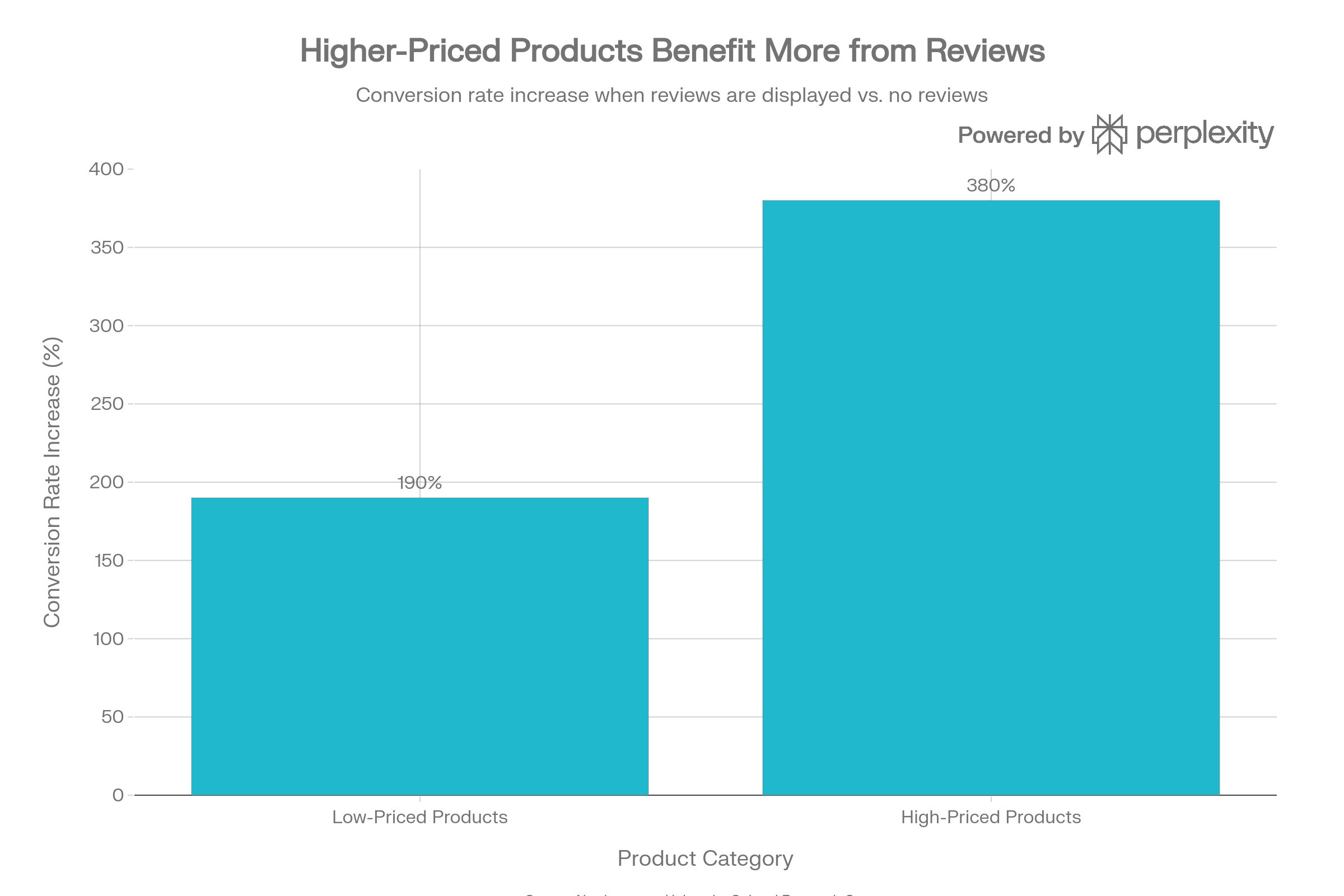
For higher-priced items, the impact of reviews on sales is even more dramatic, with conversion lifts reaching up to 380% in the same Spiegel/PowerReviews research.
Yet plenty of stores still treat ratings and the importance of testimonials like a “set it and forget it” widget. So, I’m breaking down the power of online reviews with 2026-ready stats to show you how they affect sales when implemented like a real growth lever.

Why are reviews non-negotiable for e-commerce conversions?
Online reviews are a core conversion signal in e-commerce, as they shape trust, reduce risk, and influence how visitors move along the consumer decision-making journey.
1. Reviews substitute for in-person sales assistance
Since online stores can’t offer touch, test, or expert advice, shoppers are always looking for impartial feedback from someone who has tried the product or service. That’s where reviews come in to supply real user feedback that fills that gap and builds trust at scale.
According to the Spiegel Research Center’s e-book—How Online Reviews Influence Sales—nearly 95% of shoppers read online reviews before making a purchase.
Moreover, 86% believe reviews are an essential part of the decision-making process, as reported by Retail TouchPoints, citing a PowerReviews consumer survey/report called The Power of Reviews (survey of 800 consumers).
So, when a product page has no reviews, shoppers don’t interpret it as “neutral”. They interpret it as “unknown”, and unknown is where carts go to die.
2. Social proof reduces purchase anxiety and decision fatigue
When shoppers are unsure, they look for cues from other buyers. Reviews provide that social proof, helping products move from “unproven” to “validated” in the shopper’s mind.
Research from the Spiegel Research Center shows that the first handful of reviews delivers the biggest conversion impact, because they remove uncertainty at the exact moment it matters most. Once a product has reviews, shoppers spend less time hesitating and more time deciding.
Review volume continues to influence performance beyond that initial threshold. Products with roughly 11–30 reviews convert significantly better than products with none, and many ecommerce benchmarks point to 25–50 reviews as a credibility baseline for unfamiliar brands.
3. Reviews increase perceived value without discounting
While discounts push conversions by lowering the price, online reviews push conversions by increasing confidence, as reported by data from Northwestern University and PowerReviews.
Namely, products displaying reviews convert dramatically better than those without, with conversion lifts reaching several hundred percent in some cases. The effect is even stronger for higher-priced products, where reviews act as a justification for spending more.
In practice, strong ratings and visible review volume make a product feel more reliable and premium, allowing brands to protect margins instead of racing competitors to the bottom on price.
4. The “Goldilocks zone” of star ratings: why 4.75–4.99 converts best
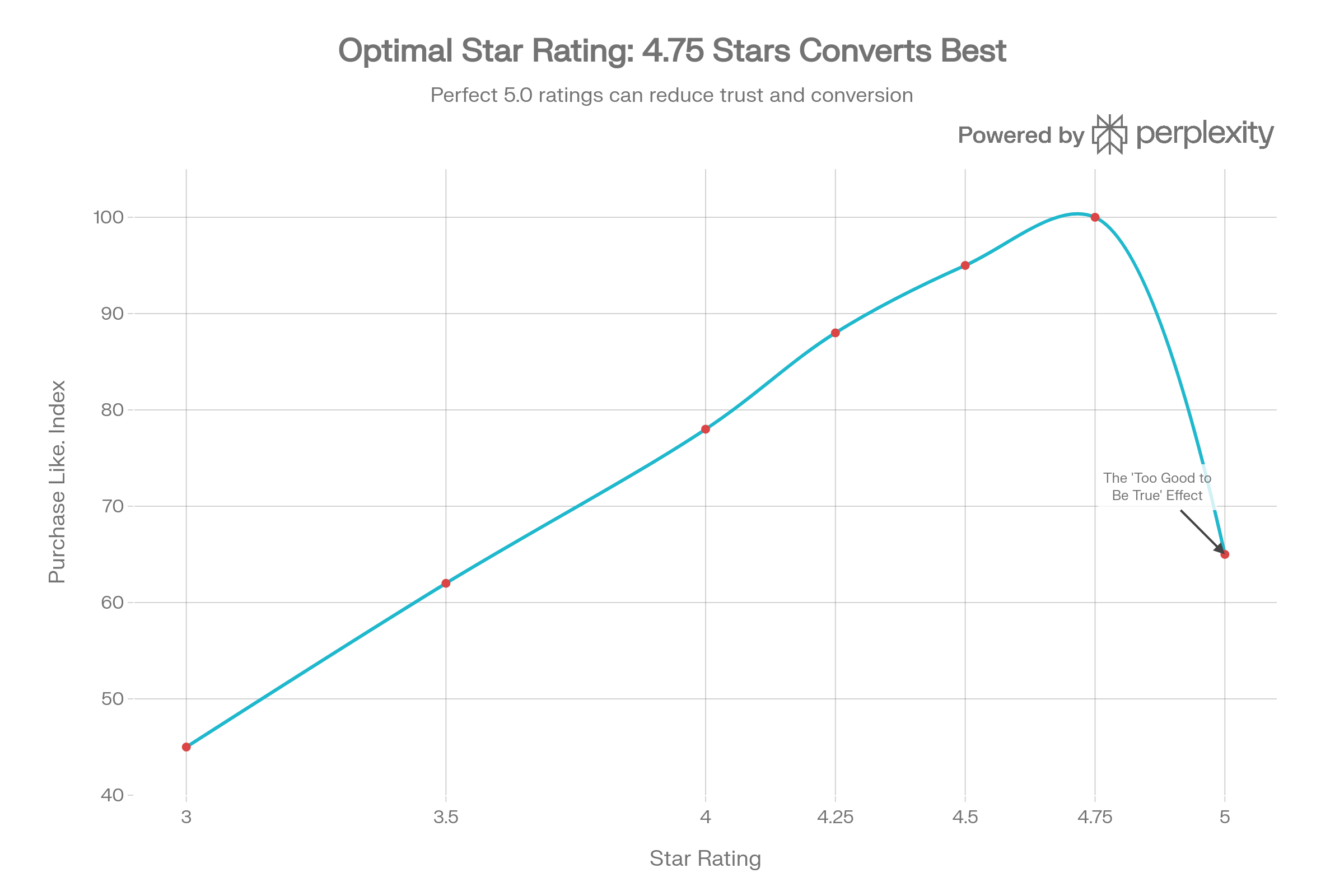
Perfect ratings don’t always perform best. Multiple ecommerce studies show that purchase likelihood peaks in the mid-4-star range, then declines as ratings approach a flawless 5.0.
PowerReviews analysis has found that ratings between 4.25 and 4.99 convert better than perfect averages, because they feel more believable to shoppers.
So, a few three- or four-star reviews add realism, reduce skepticism, and increase trust—especially for brands shoppers haven’t encountered before.
5. Responding to reviews compounds the conversion effect
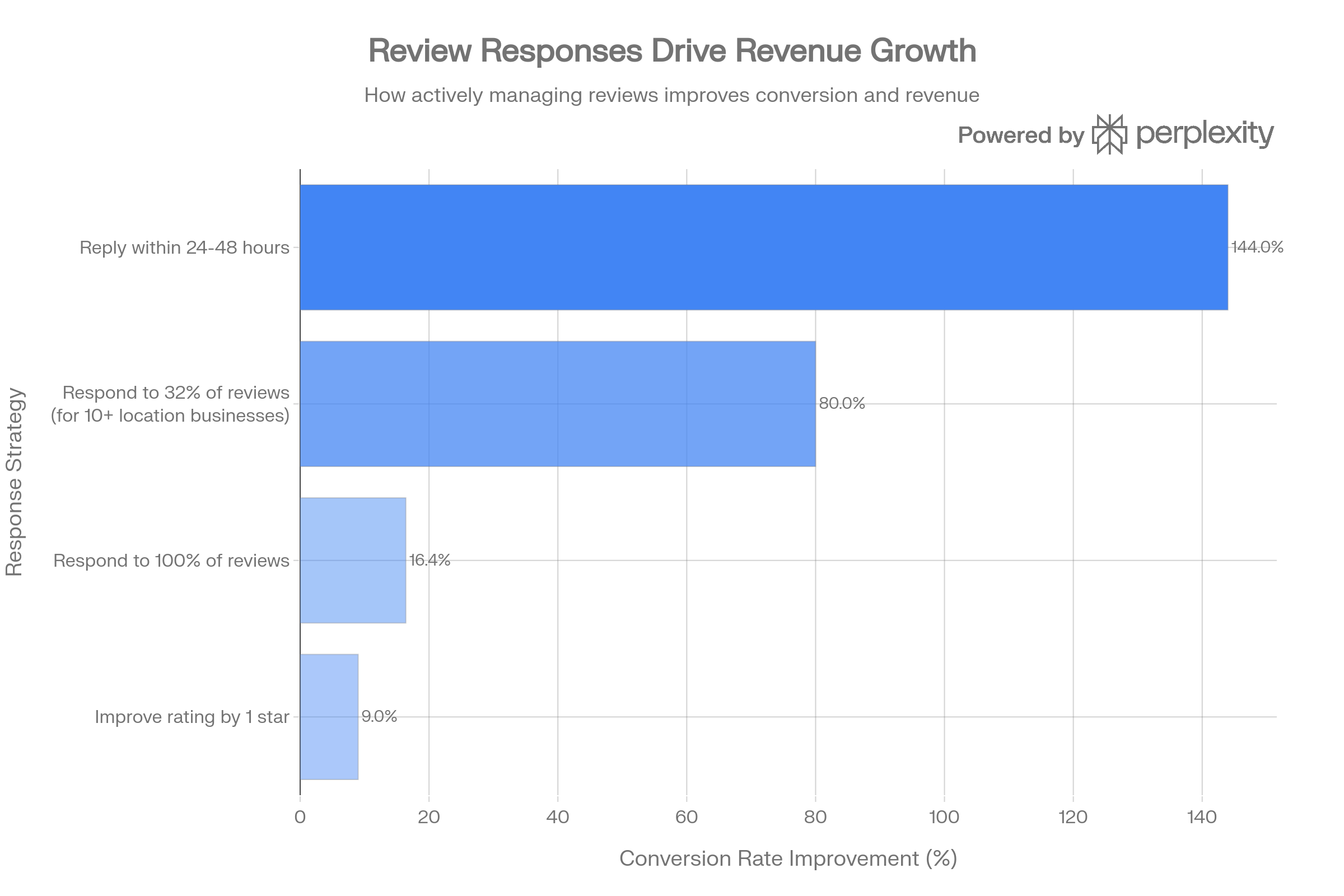
Reviews create trust. Responding to reviews amplifies them.
When shoppers see a business actively engaging with feedback, it signals accountability, reliability, and customer care, all of which are crucial at the moment of decision.
Consumer research consistently shows that customers expect businesses to respond to reviews, and that engagement positively influences trust and purchase behavior.
BrightLocal’s Local Consumer Review Survey has repeatedly found that the majority of consumers are more likely to trust—and choose—businesses that reply to reviews.
Response timing also plays a role. Faster replies reinforce the perception that a brand is attentive and customer-focused, which strengthens confidence for shoppers.
What store owners are actually saying: Real-world insights from Reddit
To complement academic research and industry benchmarks, I analyzed discussions from Reddit e-commerce communities discussing practical experiences with reviews.
r/smallbusiness: Q1: “How much do you care about online reviews for your business?”
The question: A small business owner asked how much weight other owners place on online reviews when evaluating growth and customer trust.
What store owners report: Most replies highlight that reviews directly influence first impressions and inbound demand. Several owners mention that negative reviews—or the absence of reviews—create friction before any sales conversation even begins. Reviews are repeatedly described as a credibility filter customers apply before engaging with a business.
The optimal solution: Treat reviews as a first-touch trust signal. Using a review management platform like EmbedSocial, businesses can collect, monitor, and display reviews across key decision points so prospects encounter real feedback before doubt sets in.
r/AskMarketing: Q2: “How much does online reputation affect marketing?”
The question: Marketers discussed how online reputation and reviews influence overall marketing performance.
What store owners report: Commenters agree that even strong campaigns underperform when reviews undermine trust. Paid ads may attract clicks, but users still validate brands through ratings and online store testimonials before converting. Reviews consistently affect performance beyond advertising, shaping brand perception and conversion outcomes.
The optimal solution: Align reviews with marketing execution. By embedding social proof widgets from EmbedSocial into landing pages and campaigns, brands ensure marketing and reputation reinforce each other at the point of decision.
r/Construction: Q3: “Does managing online reviews impact the bottom line?”
The question: A contractor asked whether actively managing reviews leads to measurable revenue gains.
What store owners report: Business owners report that online reviews influence lead quality and closing rates. Prospects frequently reference reviews during conversations, and visible responses often differentiate similar offers. Responding to reviews is repeatedly framed as a professionalism signal rather than just customer service.
The optimal solution: Use review responses as public proof of accountability. With EmbedSocial’s review monitoring and social listening tools, businesses can reply to reviews across platforms from one dashboard and stay consistently responsive.
r/MarketingGeek: Q4: “Are online reviews more powerful than marketing now?”
The question: A marketer asked whether online reviews have more influence on buying decisions than traditional marketing messages and brand-controlled content.
What store owners report: One commenter agrees that while marketing creates awareness, reviews finalize decisions. Many note that users often click ads or discover brands through campaigns, but then rely on reviews to validate claims before converting.
The optimal solution: Treat reviews as a conversion layer, not a replacement for marketing. By collecting and displaying verified customer feedback using EmbedSocial’s review collection and display tools, brands can reinforce marketing claims with social proof exactly where buying decisions are made.
r/googlebusinessprofile: Q5: “Are Google reviews worth focusing on?”
The question: Business owners debated whether prioritizing Google reviews delivers real value.
What store owners report: Most replies confirm that embedded Google reviews strongly influence visibility and trust. Several owners note that customers reference Google ratings explicitly before contacting them. Consistent review growth improves credibility even without aggressive promotion.
The optimal solution: Make Google reviews a foundation, not a silo. EmbedSocial’s Google Reviews widgets automatically aggregate Google reviews and display them alongside other sources in a unified, conversion-focused layout.
The numbers that matter: Core conversion statistics
To ground your review strategy in data, here are the most reliable benchmarks from peer-reviewed research and large-scale studies:
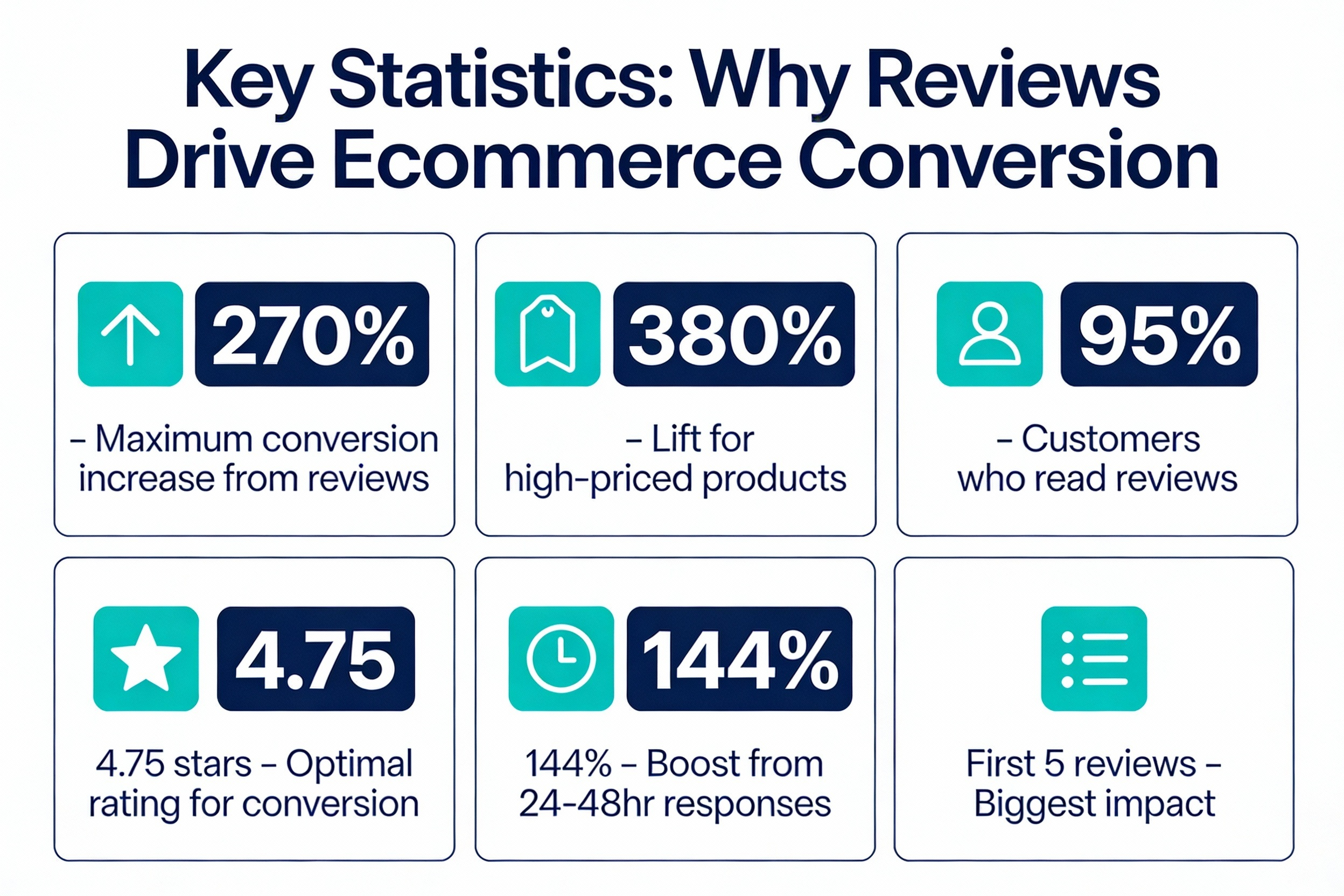
Here’s the full table covering the impact of online reviews on e-commerce conversions:
| Metric | Impact | Source |
| Displaying reviews vs. no reviews | Up to 270% conversion increase | Northwestern / Spiegel |
| High-priced product conversion lift of reviews | Up to 380% increase | Northwestern / Spiegel |
| Low-priced product conversion lift of reviews | Up to 190% increase | Northwestern / Spiegel |
| Products with 1+ reviews vs. 0 | 52% more likely to convert | PowerReviews |
| Products with 11–30 reviews vs. 0 | Double conversion rates | PowerReviews |
| Recency of reviews on their impact | 68% say they consider only reviews from the past 3 months | BrightLocal |
| Recency of review responses by brands | 63% of consumers expect a response within a week | BrightLocal |
| Minimum average star rating | Most consumers (38%) say products need at least 4 stars | BrightLocal |
As you can see, the implication is clear: the impact of online consumer reviews on sales is not a “nice to have” feature; they are, in fact, a fundamental driver of revenue.
Read more:
What We Learned from 300,000 Online Reviews: Never Seen Statistics & Trends
The State of Online Reviews in 2024 + 15 Unique Google Reviews Statistics
How to implement reviews for maximum conversion impact
To increase your conversions via your customer reviews, you must maximize their impact. So, I cover the best strategies for doing just that in the sections below.
Step 1: Prioritize review collection on high-impact products
Not all products require the same review volume. Northwestern’s research found that the first five reviews generate the largest marginal lift.
So, you should do the following:
- Identify products with zero or fewer than five reviews. These items have the most to gain from even a small number of reviews.
- Focus next on high-traffic, high-margin products. A 10% conversion improvement on a product receiving 1,000 monthly visitors is worth far more.
- Prioritize higher-priced items within each category. Expensive products benefit disproportionately, with conversion lifts up to 380% vs. 190%.
Step 2: Automate review requests with optimal timing
The single most effective method for generating reviews is the post-purchase email. Approximately 60% of all reviews originate from automated post-purchase email requests.
| Product Category | Ideal Timing After Delivery | Rationale |
| Electronics | 7–10 days | Customers need time to set up and test functionality |
| Apparel | 7 days | Time to try on and evaluate fit |
| Skincare / Supplements | 2–4 weeks | Results require sustained use |
| Food / Consumables | 1–3 days | Immediate post-delivery, while fresh in memory |
| Furniture / Home goods | 10–14 days | Assembly and initial use required |
Key insight: Email requests on Wednesday or Saturday generate higher response rates.
Game-changer: SMS review requests achieve 98% open rates (vs. 20–45% for email) with 21–40% conversion (vs. 1–15% for email).
For Shopify stores learn How to Collect Shopify Customer Reviews: 5 Tips & Tricks
Step 3: Design review sections for scannability and depth
- Display the overall star rating and review count near product titles and prices.
- Add an anchor link (“Read all reviews”) that jumps users to the full review section.
- Show 5–10 reviews by default, then a “Load more” button.
- Provide filters and sorting options: “Most recent”, “Highest rated”, “Lowest rated”, etc.
- Highlight a mix of positive and critical reviews to establish authenticity.
- Use verification badges (“Verified Purchase” or “Used for: Running”, etc.).
Platforms like EmbedSocial simplify this with various Google reviews badges and widgets that users can fully customize further.
Step 4: Respond to online reviews strategically
Responding to reviews is a conversion optimization tactic that signals accountability.
- Respond to negative reviews within 24–48 hours (52% of reviewers expect this).
- Acknowledge the issue, apologize if appropriate, and offer a solution.
- Thank customers for positive reviews to personalize and encourage future reviewers.
- Use review responses to clarify product details or usage.
AI-Powered Acceleration: EmbedSocial’s AI Responder feature drafts contextually appropriate replies in your brand voice, which you edit and approve before publishing.
Step 5: Integrate reviews into your broader marketing ecosystem
- Enable Google rich snippets via schema markup for search results.
- Feature reviews in email campaigns and retargeting sequences.
- Use reviews in paid ads (Facebook and Google allow review snippets).
- Display aggregated reviews on your homepage with carousel widgets.
- Create shoppable UGC feeds by tagging customer photos with product links.
Learn how to add Google reviews to your website for search visibility. Discover how to collect video reviews, which often convert better than written feedback.
Case studies: Real conversion gains from review implementation
Grace Loves Lace creates unforgettable bridal experiences across the world and has gotten up to +87% more booking clicks thanks to EmbedSocial’s live reviews widgets.
Moreover, Plutio, a SaaS company, attributed measurable conversion improvements to the implementation of online reviews on their website CTAs. After all, the impact of online reviews on consumer perception was evident in their increased CTR numbers.
Key takeaway: When reviews are implemented strategically—placed near decision points, kept fresh with automation, and displayed in clean, scannable formats—double-digit conversion improvements are typical in most scenarios.
4 best practices for overcoming common obstacles
You only have to keep track of a few snags along the way when setting up your review collection process. Here are some of the most common:
❌ “I’m afraid of getting negative reviews.”
Reality: Negative reviews, when managed well, often increase conversion. A few critical reviews mixed with positive ones signal authenticity. Research shows the impact of online ratings and reviews in the 4.0–4.75 range converts better than perfect 5.0 averages.
❌ “I don’t have enough customers yet to generate reviews.”
Reality: You only need 5–10 reviews per product to unlock the majority of the conversion benefit. Consider running a product sampling campaign, or use a simple e-shop review form to make it easy for customers to leave feedback.
❌ “Review platforms are too expensive or complicated.”
Reality: EmbedSocial offers free and low-cost tiers allowing you to aggregate reviews from Google and Facebook and create unlimited widgets without technical expertise. You can even get a forever-free Google reviews widget to get started.
❌ “My competitors don’t use reviews, so I don’t think they matter in my niche.”
Reality: If competitors aren’t using reviews, you have an opportunity to differentiate and capture share. The store with visible, credible reviews will often win the sale, even if priced slightly higher.
13 ways online reviews impact your brand reputation
Here is what 13 thought leaders had to say when asked to talk about the impact of online reviews on their brands and businesses, and the power of reviews to grow their bottom line.
Reviews drive R&D fixes and SEO wins
For us, reviews serve as our basis for Research and Development. Reviews are good for marketing and even better for R&D to avoid repeating mistakes. They are honest experiences that guide us on what we need to fix.
We were getting 3 and 4-star reviews for our white-oak storage bed in our first year. Never got a 5-star and the reviews had one complaint in common. The customers said they loved the look and quality, though they struggled with one bolt during assembly. We discussed this with the development team. They changed the hardware kit for our next sales and updated the assembly guide.
The reviews got better and our customer tickets asking for help setting it up for that SKU dropped by 11%. We did all this in one production cycle without hiring a consultant. Customers felt heard and came to trust that we would immediately work on any downsides to our products. This trust helped build our reputation.
The bottom line is the Search Engine Dominance that comes with reviews. Every time a customer writes a review, the content is authentic, fresh and contains natural language. All factors that Google’s algorithm prioritizes. Thus, they are technically handling our SEO for us.
Loc Dang, Marketing Executive, Mim Concept
Reviews build trust and fuel ROKR sales
Online reviews have a huge impact on our brand at ROKR because they are one of the most trusted sources of information for potential customers. Customers who want to buy our 3D wooden puzzles or creative toys will read reviews to find out about product quality and assembly difficulties and overall user experience. Our positive reviews confirm the special design and high-quality materials of our products which helps us improve our Amazon and Etsy and Google rankings that increase traffic to our product pages.
Negative or constructive reviews provide us with information about our packaging and instructions and customer support systems which we need to improve while our customer responses can change unhappy customers into dedicated supporters. The accumulation of authentic reviews helps strengthen our online reputation, builds trust with new customers, and ultimately contributes to sales growth, because people are much more likely to purchase a product that others have genuinely recommended.
Alfred Christ, PR Executive & Marketing Specialist, Robotime
Reviews convert and serve as sales channel
Online reviews serve as the ‘front door’ to our business. Before any customers call us, they read reviews from strangers about us. At LAXcar, our 5.0 Google rating not only looks good, but it also converts. We’ve even had customers point out specific reviews that influenced their decision to book.
Locations with better reviews receive more requests, and reviews shape trust better and faster than advertisements. BrightLocal states that 98% of customers pay attention to online reviews for nearby businesses, and they often consider them personal recommendations (source). We’ve also seen a direct correlation between response times, the quality of service, and the quantity of bookings.
There is no other way to say it – reviews are a sales channel. If service is lacking, reviews make it clear. If service is outstanding, reviews will sell it for you – even when you’re not working.
Arsen Misakyan, CEO and Founder, LAXcar
Reviews shape what AI says about you
When someone asks ChatGPT or Perplexity “What is the best pizza place in CITY?” or “Is [Brand X] worth buying?”, the AI pulls from review content to form its answer. If your reviews mention specific features, quality, service, or problems, that language ends up in the AI’s response.
LLMs parse information from online reviews and cite them when a user asks about a brand. Therefore, these online reviews are more important than ever nowadays. And for local SEO, Google reviews were always important. But now, they are more than just a ranking signal.
You are no longer just managing reviews for Google’s star rating. You are now managing what AI tells people about you before they even visit your website.
Burak Özdemir, Founder, Online Alarm Kur
Stellar reviews win high-risk merchant clients
We’re in a very sensitive market, high risk merchant accounts and it’s also very competitive. We have two groups of customers: those who need a merchant account YESTERDAY and will go for the first one that gets them approved. The second group is switching from another merchant and they have all the time in the world for research.
For this audience, reviews are crucial, especially TrustPilot reviews and most recently Reddit. If your reviews are not stellar, you’re leaving money on the table because competitors are driving customers to their profiles and asking for 5* reviews all day long.
Daniel Kroytor, CEO, TailoredPay
Reviews sway clicks, not map rankings
In my experience as a small SEO agency owner, review quality and quantity barely affect Google Business Profile rankings, if at all. What reviews do affect is conversion. Only three non-sponsored results show in the map pack before you have to click “More Businesses.” And let’s be honest, nobody does that. So if one business has 1 review and the other two have 50 or more, which one are you calling?
Tyler Henn, Owner, hennhouse
Midrange reviews drive product improvements and retention
I used to dread the sound of the notification bell. It meant, usually, another customer with a big mouth. Early in my career, I launched a basic software tool. I thought it was perfect. Then a scathing two star review came in. The user claimed that the interface was confusing and required “too many clicks.” My ego took a hit. I wanted to argue. Instead, I emailed them directly. And we corrected the workflow based on that one complaint.
That little change reduced our churn rate by ten percent in a month. Most business owners treat the reviews as vanity metrics. They beg for 5 stars just to look nice on Google. That is a waste of time. The real money is in the three-star reviews. These people like your brand enough to purchase it but care enough to tell you the truth. And they provide you with free consulting. If you ignore them, you lose money. If you listen, you create a product that sells itself. Stop worrying about “reputation management” and start using reviews for product development. It costs nothing and works better than any costly focus group I have ever hired.
Reviews power social proof and local prominence
Online reviews are the currency of digital “social proof” necessary to survive in 2026. Reviews are a powerful trust signal as more than 93% of consumers read them before they make their purchase and in many cases even value them higher than traditional marketing. And a strong profile is more than mere reputation-building: It’s an engine of conversion stellar ratings can drive up a customer’s willingness to pay by as much as 31%.
Technically, reviews are the leading factor in local SEO where “prominence” is concerned. Google values volume and recency, moving your business into that coveted local pack. Responding to every kind of feedback is a demonstration of intense involvement, it converts skeptics into die hard enthusiasts and obviously increases your bottom line.
Zack Moorin, Founder, Zack Buys Houses
Reviews lift visibility, trust, and sales
Reviews are a lifeline for local businesses like LINQ Kitchen. From a marketing perspective, they directly affect our visibility in Google search results. Collecting genuine reviews, particularly recent ones, consistently signals to Google that we are an active business, which may improve our local search rankings.
Responding to both positive and negative reviews is important. Interacting with customers in this manner creates the perception that we truly value their opinions and experiences with our company. Responding positively to negative reviews will also demonstrate that we take responsibility for issues that arise during your purchase and are committed to improving our products.
Positive reviews function as a testimonial to our ability to deliver high-quality products and excellent service in custom cabinetry and luxury closet design. They serve as social proof for potential customers, and by actively monitoring our online reviews and incorporating them into our marketing strategy, we build credibility and attract additional business.
Reviews also allow us to utilize social proof within our marketing materials. We showcase customer testimonials on our website, brochures, and advertisements to build confidence and credibility in our ability to deliver quality products and services.
In addition to building credibility, reviews also give us a competitive advantage in a crowded market such as kitchen remodeling. A large body of positive reviews clearly signals to potential customers that we produce high-quality products and stand behind our service, increasing the likelihood that they will select us as their provider.
Josh Qian, COO and Co-Founder, LINQ Kitchen formerly BestOnlineCabinets
Fresh reviews beat perfect scores for revenue
Everyone looks at the star rating, but recency matters way more for your revenue. I once consulted for a local restaurant chain that was losing money although they had a 4.8 rating. They could not understand why the dining room was sitting empty. I looked at their Google profile and saw where the problem lay immediately. Their last review was 6 months ago.
To a potential customer, a dormant review section conveys that you may have closed down or stopped caring. We conducted a quick campaign just to get new feedback. The rating actually fell to a 4.6 on the basis of a few complaints, but foot traffic doubled within a month. Fresh reviews let the algorithm and the customer know that you are open for business right now. It is preferable to have a slightly lower score with reviews from yesterday rather than having a perfect score and reviews from last year. Cash flow is in the activity, and not the perfection
Rengie Wisper, Marketing Lead, Escrowly.com
Strong ratings unlock trust and revenue advantages
The online reputation is almost entirely dependent on the social evidence of reviews. In a world in which customers now consider peer recommendations as more trustworthy than ad campaigns, that star rating has become the de facto trust symbol. This visibility has an impact on the financials, directly functioning as a conversion engine; incremental improvement in your average ratings can drive step improvement to revenue by allowing premium pricing and reducing customer acquisition costs.
Strategically, ratings help you dominate local (SEO) prominence. Search algorithlms favor businesses which are observed with high frequency and in a positive light, so these hit the “local pack” that you often see in local search results. Dissecting negative and positive feedback in real time is active management; it’s how you create brand loyalty in the long run or protect yourself from potential damage to your reputation.
Amanda New, Founder, Cash For Houses Girl
Agency leverages reviews to grow traffic and sales
Dave Toby here. As the Managing Director of Pathfinder Marketing, a digital agency which builds performance strategies for SMEs, through SEO, paid media, and marketing automation, I lead the teams at Pathfinder to deliver real traffic, leads and sales. I have been able to show my clients the proven methods of building their businesses’ reputation, as I know how reviews turn browsers into buyers.
Your online reputation matters to your business because customers search online for reviews before they click on websites or store addresses and it is true with every client we onboard with Pathfinder. For example, one of our retail clients was able to increase their overall rating from 3.2 to 4.1 in just three months and were able to increase their organic traffic by 27% while doing so. With positive reviews, customers will be confident about buying from businesses with strong customer feedback. Negative reviews will create immediate loss of trust among potential customers and will lose customers quickly.
We take control of claiming clients’ online profiles and responding to all of their reviews. Reviews will move businesses up in local map rankings, as four-star businesses always rank above three-star ones. If you track your local map rankings daily, you can easily see how the number of stars you have influences your ranking. Reputation drives sales growth and we see the results weekly through data.
Dave Toby, Managing Director | Digital Marketing Specialist, Pathfinder Marketing
Review volume, recency, and keywords drive local SEO
Reviews from an SEO perspective are one critical ranking factor in local SEO. Google will look at the volume, frequency (even more important after gaining a specific amount of reviews) and the content/keywords that are used in the reviews. In just starting out our t-shirt business, we noticed a impactful increase in gaining and adding Google reviews to our website on our individual product pages after a few months in business.
We’ve also seen a jump in impressions and clicks from our Google My Business profile in and around the area that our office is located.
Mr. John Sammon, CEO, Diehard Local
Conclusion: Reviews are an important revenue infrastructure!
The customer reviews impact is not a nice-to-have feature; it’s foundational infrastructure for e-commerce revenue growth. The data is unambiguous:
- Reviews increase conversion rates by double or triple digits
- They disproportionately benefit higher-priced products (380% vs. 190%)
- They compound over time as review volume and search visibility improve
Yet the majority of online stores under-invest in review strategy. The stores that win treat reviews as strategic assets:
- Prioritize review collection on high-impact products
- Automate review requests with precise timing and use SMS
- Design review sections for scannability and authenticity
- Respond to reviews quickly and professionally
- Integrate reviews across your marketing ecosystem
Remember: If you are not yet systematically collecting and displaying reviews, you are leaving revenue on the table.
Start with your top 10 products by traffic or margin, set up an automated post-purchase email sequence, and choose a platform like EmbedSocial that aggregates negative and positive reviews from multiple sources with customizable review widget templates.
The stores that treat reviews as strategic assets, not afterthoughts, will capture disproportionate share in every market they compete in.
FAQs about the impact of online reviews
How powerful are online reviews?
Online reviews are one of the strongest trust and conversion signals in digital commerce. They influence consumer perception early and directly affect purchase decisions, especially for unfamiliar brands. Consumers’ purchasing decisions rely on positive feedback and negative feedback alike. They need the whole picture during the consumer decision-making process.
What are the advantages of online reviews?
They build trust, reduce purchase anxiety, improve conversion rates, and increase perceived value without discounting. Reviews also support SEO and long-term brand credibility. Online consumer behaviour relies on customer feedback at all times.
What is the impact of reviews on businesses?
Reviews shape brand reputation, influence sales performance, and affect how marketing efforts convert. Businesses with strong, well-managed online customer reviews consistently outperform competitors with weak or absent social proof.
How reviews affect sales for e-commerce brands?
Reviews increase sales by building trust, reducing purchase anxiety, and validating product quality at the decision stage. For e-commerce brands, visible ratings and customer satisfaction directly improve conversion rates and average order value, especially for new or unfamiliar stores.
What are the disadvantages of online reviews?
Negative reviews can harm perception if ignored or poorly handled. Reviews also require active management, transparency, and consistent responses to avoid trust erosion. Consumer behavior is adjusted when users submit reviews, as they can either discourage or encourage customers to make a purchasing decision.