

2026 is the year review management software stopped being a nice-to-have and became the operating layer for how brands earn trust online. AI-powered workflows now draft replies, catch sentiment shifts, and spot fake ratings so teams can focus on the customers who actually need attention.
Picking the right review management software also matters more than a year ago. Local ranking signals now weight review recency and response rate, and AI search answers pull heavily from first-party review content.
Conversion tests on product pages routinely show a 10 to 30 percent lift when review widgets are wired up correctly. That is why brands owning the display layer show up in more places than brands that only rely on third-party profiles.
This guide walks through the 12 best tools for 2026, with pricing, pros, cons, and honest picks by segment. For the operating playbook end-to-end, our review management guide covers the workflow, and our review management software page shows how EmbedSocial runs it in one dashboard.
If you are still figuring out where to collect reviews on your website, start there first, then come back to compare tools below.
What is review management software?
Review management software is a platform that lets a business monitor, respond to, request, collect, and display customer reviews from a single dashboard across the sites that matter (Google, Facebook, Yelp, Trustpilot, Tripadvisor, industry directories, and your own website).
Most tools blend six core capabilities:
- Aggregation from Google Business Profile, Facebook, Yelp, Trustpilot, Tripadvisor and vertical review sites
- Response workflows with team assignments, templates, and now AI-drafted replies
- Review requests via email, SMS, WhatsApp, QR code, or NFC card
- On-site display through widgets, badges, and shoppable review UGC
- Analytics on rating, sentiment, response time, and review velocity
- AI features: summaries, sentiment tagging, fake-review detection, auto-replies
The distinction between “review management” and full online reputation management software is narrowing. Modern platforms cover both, and the buying question is usually about depth in one area (local SEO, ecommerce, enterprise governance) rather than feature parity.
Review management software comparison table
Each tool name jumps to its full profile below.
| Tool | Starting price | Free trial | Best for | Standout feature |
|---|---|---|---|---|
| Birdeye | $299/mo per location | On request | Multi-location businesses and franchises | AI reply agent |
| EmbedSocial | $29/mo (Pro) | 7-day free trial | AI review widgets and website display | AI review assistant |
| Localith | $29/mo (Basic) | Free plan | Local businesses and Google reviews at scale | Multi-location Google workflow |
| Podium | $399/mo (Core) | On request | Messaging-first review requests | AI Employee |
| Trustpilot | $259/mo | Free plan | Ecommerce trust signals | Google Seller Ratings feed |
| Yotpo | $19/mo (Growth) | Free plan | Shopify and DTC brands | Reviews plus loyalty bundle |
| Reputation | ~$500/mo per location | On request | Enterprise reputation intelligence | Reputation score benchmarking |
| BrightLocal | $39/mo (Track) | On request | Local SEO agencies | Reviews plus local rank tracking |
| Bazaarvoice | Custom | On request | Enterprise UGC and syndication | Retail Syndication Network |
| Vendasta | Free (Startup) | Free plan | Marketing agencies and resellers | White-label marketplace |
| Yext | $199/mo (Emerging) | On request | Listings and knowledge graph management | 200+ publisher network |
| ReviewFlowz | $49/mo (Solo) | On request | Automated AI review replies | AI reply automation |
For EmbedSocial the trial is 7 days, all features included.
The 12 best review management software tools for 2026
1. Birdeye: Best for multi-location businesses and franchises
- Best for: Multi-location businesses and franchises
- Starting price: $299 per month per location
- Free trial: On request
- Standout feature: AI reply agent across reputation, listings, and messaging
Birdeye is the default choice for multi-location businesses that need reputation, listings, and messaging under one roof. Its footprint across dentists, home services, auto, real estate, and healthcare franchises makes it the platform most agencies encounter first.
The 2026 release cycle leaned hard into AI: a native reply agent, competitor benchmarking, and journey analytics that tie reviews to referral and repeat business. The tradeoff is scope. Birdeye is big, and small businesses often pay for modules they never turn on.
| Pros | Cons |
|---|---|
|
|
2. EmbedSocial: Best for AI review widgets and website display
- Best for: AI review widgets and website display
- Starting price: $29 per month (Pro plan)
- Free trial: 7-day free trial, all features included
- Standout feature: AI review assistant with best-in-class widget templates

EmbedSocial is a review and UGC platform built for teams that care about how reviews look on their own website, not only on third-party profiles. Its AI review widgets, AI review assistant, and universal collection across Google, Facebook, Yelp, Trustpilot, and more make it the go-to for brands that want first-party display alongside broad aggregation.
The 2026 release added the AI review assistant that drafts brand-voice replies, an AI review response agent that can auto-reply on Google Business Profile, and expanded NFC and QR-based request cards. Explore the reviews widget library and the AI reviews feature set for the full picture.
On the management side, reviews get the same tagging as every other post: tag them one at a time, in bulk, or with AI, then filter by tag. Connect EmbedSocial to Claude or ChatGPT with MCP to pull any widget’s reviews, UGC and analytics into the chat and ask for a custom report that combines your reviews with your other UGC sources, with no exporting. See how it fits together on the review management page.
| Pros | Cons |
|---|---|
|
|
See reviews pricing for the full breakdown.
3. Localith: Best for local businesses and Google reviews at scale
- Best for: Local businesses and agencies managing Google Business Profile reviews at scale
- Starting price: $29 per month (Basic plan)
- Free trial: Free plan available
- Standout feature: Multi-location Google Business Profile workflow at SMB pricing
Localith is a Google-first platform built for local businesses managing reviews across many Google Business Profile locations. Its sweet spot is agencies and multi-location SMBs that need Google reviews collected, responded to, and displayed at volume without paying enterprise prices.
If your review universe is 90 percent Google Business Profile and you need to manage Google multi-location reviews with per-location analytics, Localith is one of the cheapest ways to do it.
| Pros | Cons |
|---|---|
|
|
4. Podium: Best for messaging-first review requests
- Best for: Local and multi-location businesses that turn conversations into reviews via text
- Starting price: $399 per month (Core plan)
- Free trial: On request
- Standout feature: AI Employee autonomous receptionist and reply agent

Podium built its brand around text-message review requests, and that focus still shows. Its Core, Pro, and Signature tiers wrap SMS at the center of the workflow: send a request, chat with the customer, close the loop with a Google review.
The 2026 lineup adds AI Employee (an autonomous receptionist and reply agent) and a payments layer that ties reviews to revenue. If your operation runs on inbound texts, Podium fits like a glove. If most of your reviews come from ecommerce checkouts, it is overkill.
| Pros | Cons |
|---|---|
|
|
5. Trustpilot: Best for ecommerce trust signals
- Best for: Ecommerce and DTC brands that want a recognized trust badge
- Starting price: $259 per month
- Free trial: Free plan available
- Standout feature: Google Seller Ratings feed out of the box
Trustpilot is the trust label most European and DTC ecommerce buyers already recognize. Its consumer-facing profile drives search-visible star ratings, and its widgets are the industry default for product and checkout pages.
The catch is that Trustpilot is a two-sided marketplace: your profile lives on Trustpilot’s domain whether you pay or not. Paid tiers unlock invitation, moderation, and display features. Read our full walkthrough on how to embed Trustpilot reviews if you already collect there.
| Pros | Cons |
|---|---|
|
|
6. Yotpo: Best for Shopify and DTC brands
- Best for: Shopify and DTC brands that want reviews wired into loyalty and retention
- Starting price: $19 per month (Growth plan)
- Free trial: Free plan available
- Standout feature: Reviews bundled with loyalty and SMS marketing
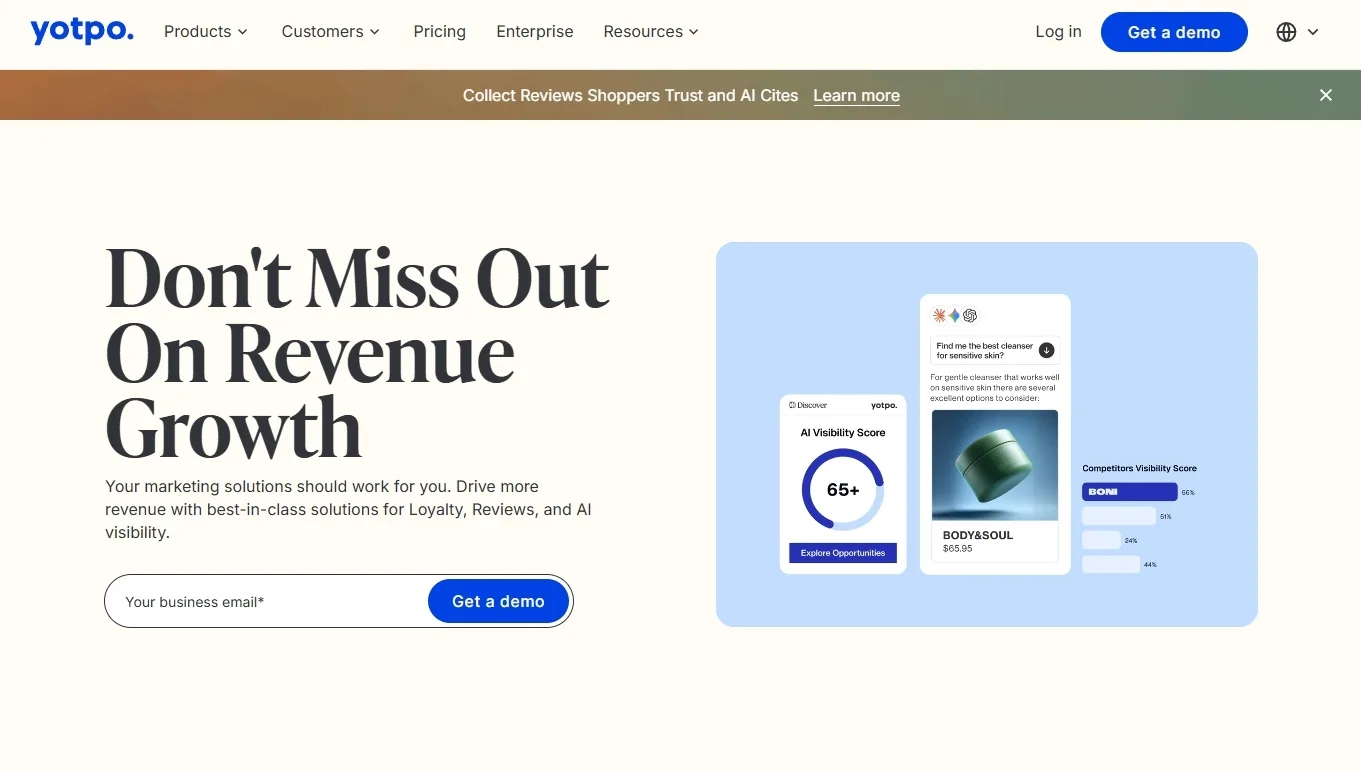
Yotpo is the review platform Shopify DTC brands reach for by default. It bundles reviews with loyalty, SMS, and subscriptions, so it doubles as a retention marketing stack rather than just a review tool.
The tradeoff is lock-in and pricing that scales with order volume. For a growing DTC brand, Yotpo pays off. For a service business, it is overkill. See our Yotpo alternatives roundup for competitor picks.
| Pros | Cons |
|---|---|
|
|
7. Reputation: Best for enterprise reputation intelligence
- Best for: Enterprise brands that need reputation intelligence tied to competitive benchmarking
- Starting price: ~$500 per month per location (custom)
- Free trial: On request
- Standout feature: Reputation score and CX benchmarking

Reputation (formerly Reputation.com) is an enterprise reputation intelligence platform. It aggregates reviews, surveys, and social listening into a single “reputation score” that ties customer sentiment to business outcomes, then benchmarks that against your competitors.
This is the tool for the enterprise buyer whose CFO wants a defensible number, not a wall of quotes. It is also priced like one.
| Pros | Cons |
|---|---|
|
|
8. BrightLocal: Best for local SEO agencies
- Best for: Local SEO agencies that want reviews alongside citations and rank tracking
- Starting price: $39 per month (Track plan)
- Free trial: On request
- Standout feature: Reviews inside a full local SEO workspace
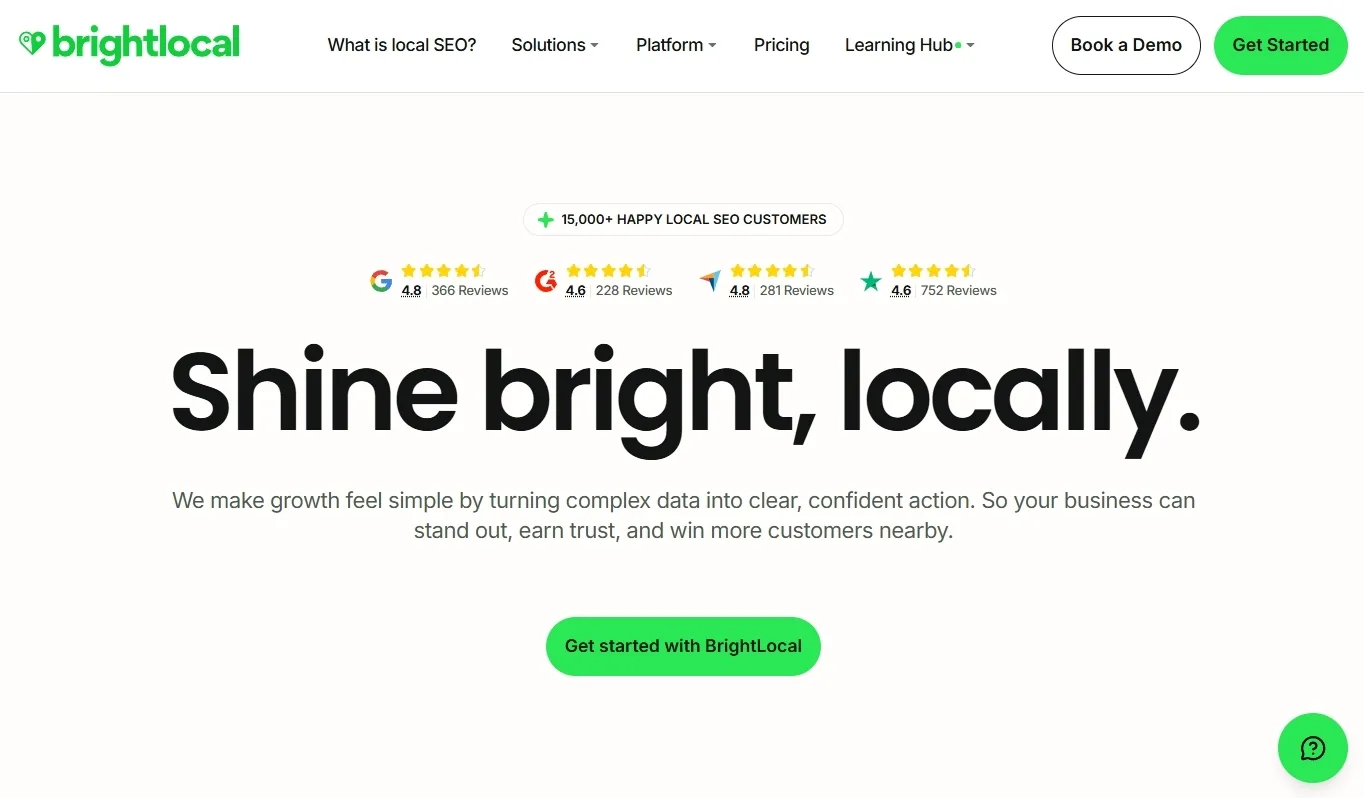
BrightLocal is a local SEO platform first, and a review tool second. That framing is exactly why it is popular with local SEO agencies: reviews sit alongside citation building, rank tracking, and audit reports in the same workspace.
If your agency sells local SEO retainers, BrightLocal is one of the cheapest ways to add a review management layer without adopting a second stack.
| Pros | Cons |
|---|---|
|
|
9. Bazaarvoice: Best for enterprise UGC and syndication
- Best for: Enterprise brands that syndicate reviews across large retail partner networks
- Starting price: Custom (typically $10,000 to $200,000 per year)
- Free trial: On request
- Standout feature: Retail Syndication Network across 1,750+ sites
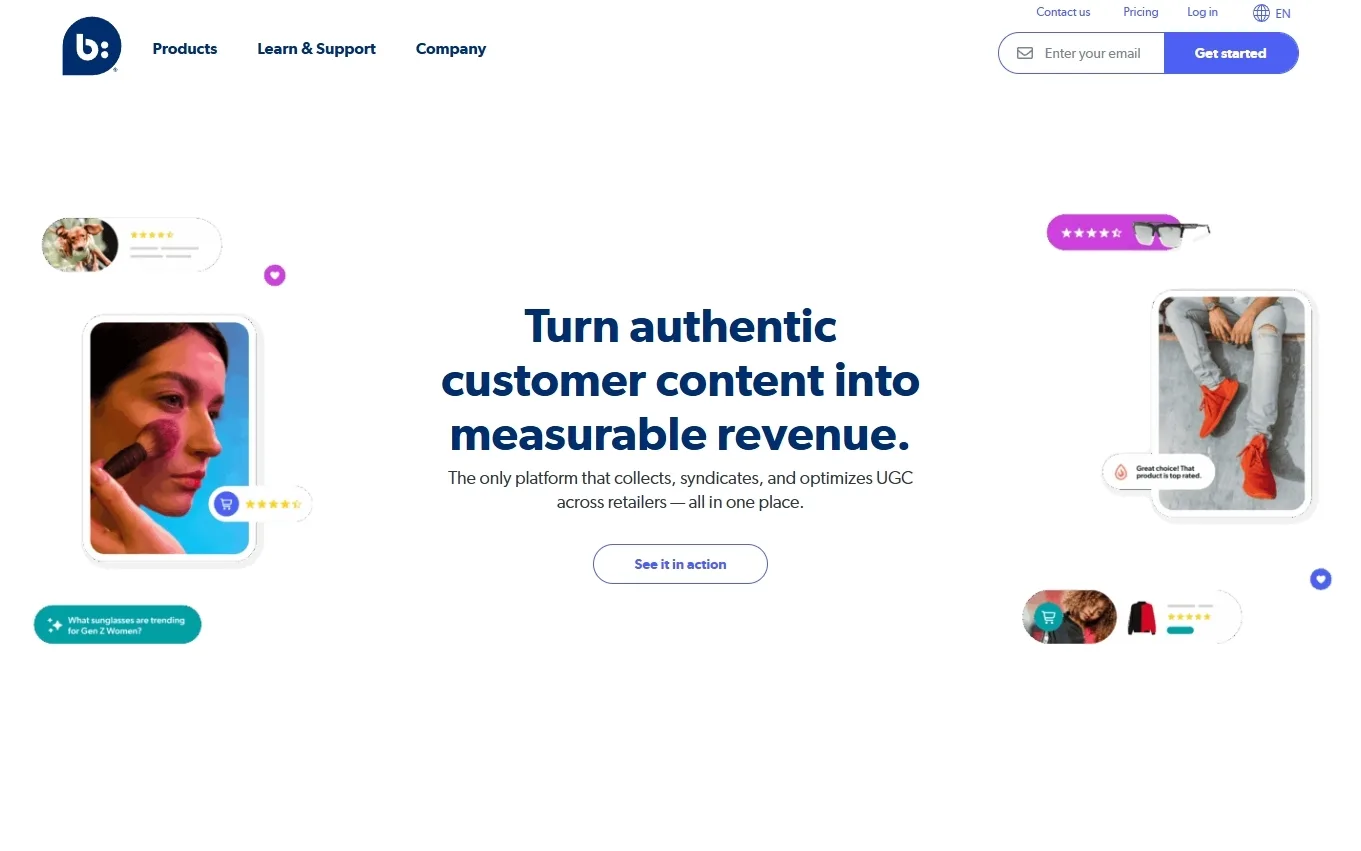
Bazaarvoice is the enterprise UGC and review syndication platform. Its Retail Syndication Network pushes verified reviews from brand sites out to Walmart, Target, Amazon retail partners and 1,750+ retailers, which is why enterprise CPG and consumer electronics brands use it.
You buy Bazaarvoice for the network, not just the software. If you sell through retailers, that network is uniquely valuable. If you do not, you are paying for capabilities you cannot fully exploit.
| Pros | Cons |
|---|---|
|
|
10. Vendasta: Best for marketing agencies and resellers
- Best for: Marketing agencies and resellers that white-label review tools to local business clients
- Starting price: Free (Startup plan), Essentials from $79 per month
- Free trial: Free plan available
- Standout feature: White-label marketplace of resellable products
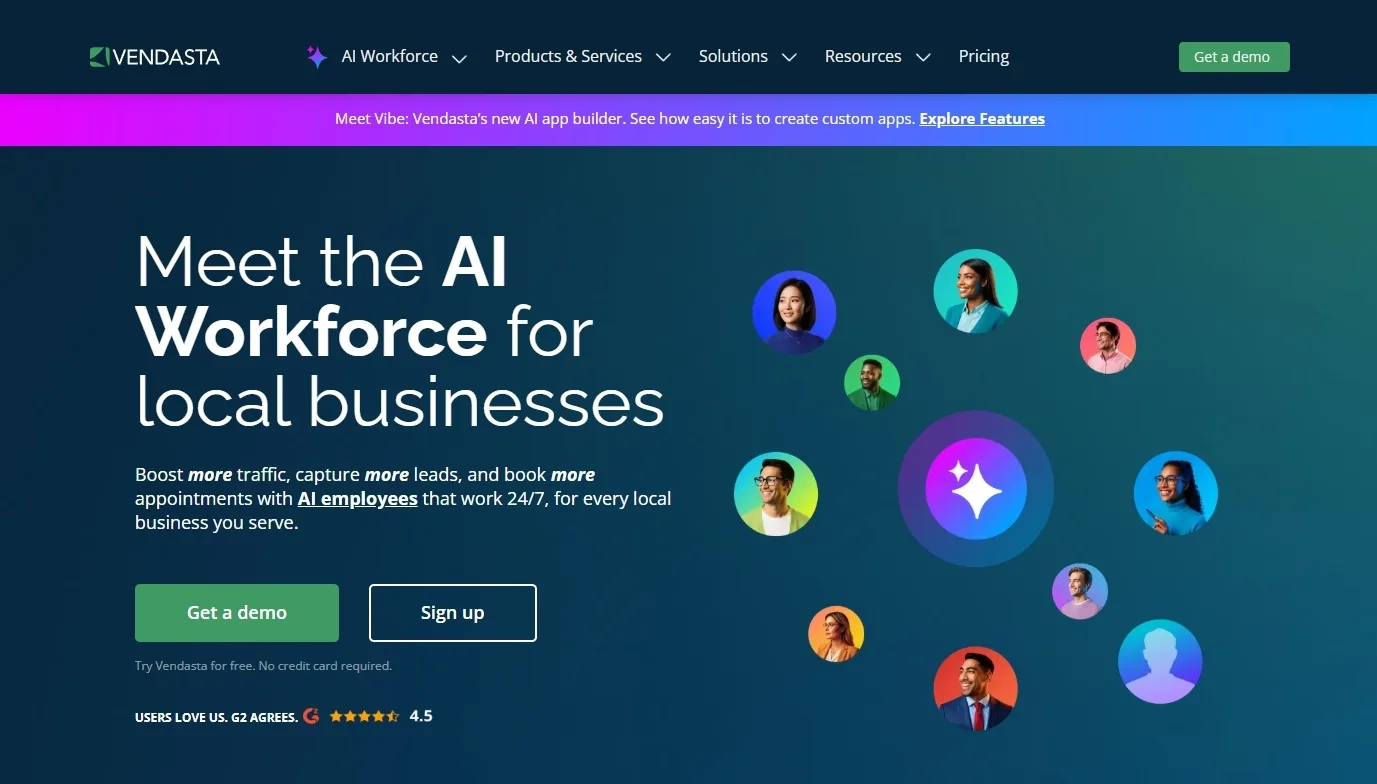
Vendasta is a channel-partner platform for marketing agencies and resellers. Its review module sits inside a broader marketplace where agencies sell reviews, listings, social, and websites to their SMB clients under their own brand.
If you sell services to local businesses, Vendasta is a business model, not just a tool. If you only want to manage your own reviews, look elsewhere.
| Pros | Cons |
|---|---|
|
|
11. Yext: Best for listings and knowledge graph management
- Best for: Multi-location brands that need consistent listings across a wide publisher network
- Starting price: $199 per month (Emerging plan)
- Free trial: On request
- Standout feature: Listings management across 200+ publishers
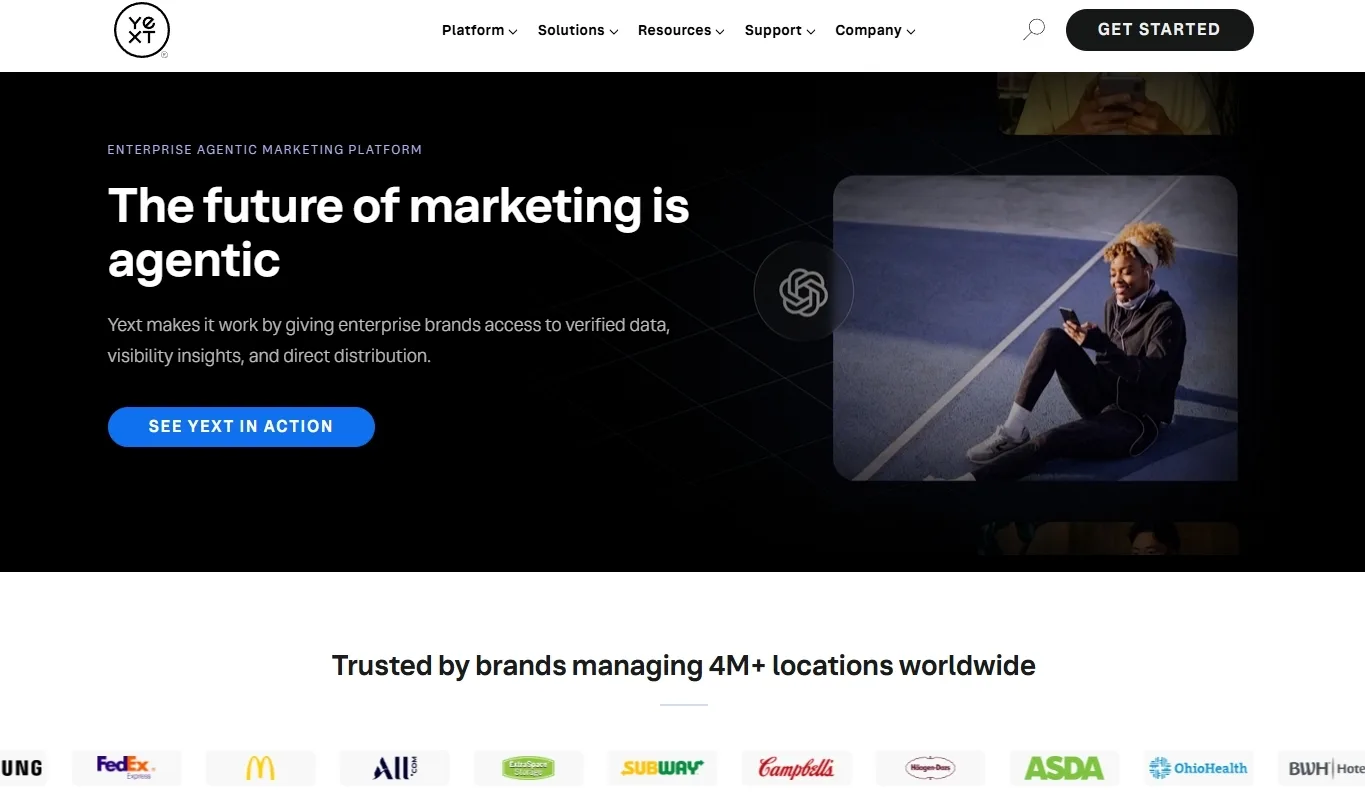
Yext is a knowledge graph and listings platform, with reviews as an adjacent module. If your problem is keeping business information consistent across hundreds of directories, GPS systems, and voice assistants, Yext solves that first.
Reviews inside Yext are competent but rarely the reason enterprises pick it. Think of Yext as the listings layer that also does reviews, not the other way around.
| Pros | Cons |
|---|---|
|
|
12. ReviewFlowz: Best for automated AI review replies
- Best for: Teams that want automated, AI-drafted review replies across many sources
- Starting price: $49 per month (Solo plan)
- Free trial: On request
- Standout feature: AI reply automation across G2, Capterra, Trustpilot, App Store, Google, and Facebook
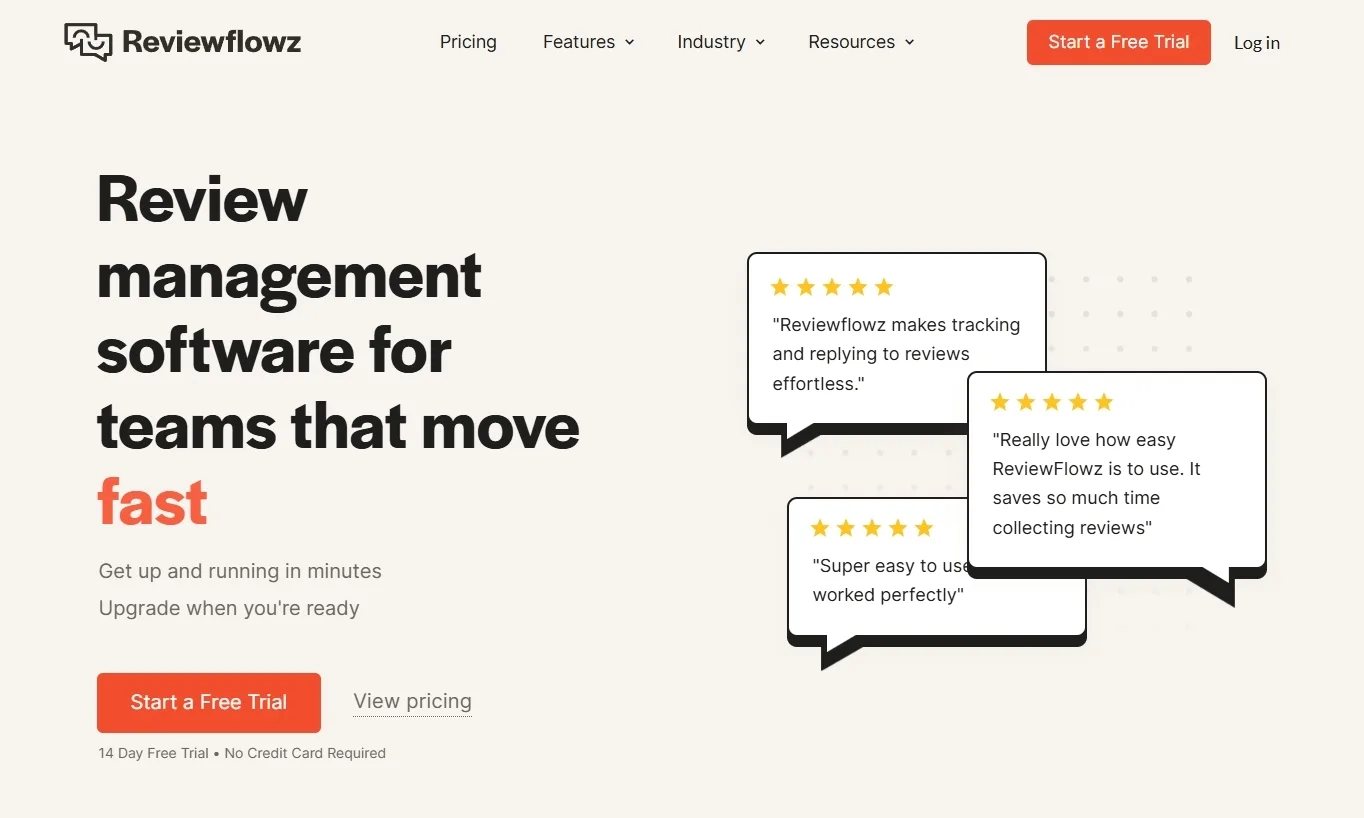
ReviewFlowz is the newer entrant that leans entirely into AI-driven review reply automation. It monitors reviews across G2, Capterra, Trustpilot, App Store, Google, and Facebook, then drafts or auto-sends replies in the brand’s tone.
If your operation is drowning in reply volume and you want an AI layer that plugs into your existing workflow, ReviewFlowz is one of the cleanest picks. If you also need review requests, widgets, and analytics, pair it with a broader platform.
| Pros | Cons |
|---|---|
|
|
Review management statistics
These figures come from the EmbedSocial Online Reviews Report, our analysis of 324,404 Google and Facebook reviews published between 1 January and 21 December 2021. Each one links to its finding, so you can cite it directly.
| Finding | Figure |
|---|---|
| Share of analyzed reviews that are Google reviews | 91% |
| Google reviews that include written text | 68% |
| Google reviews that are 5 stars | 86% |
| Google reviews that are 1 star | 4% |
| 1-star Google reviews that include written text | 80% |
| Facebook recommendations that are positive | 92% |
What it means for review management: most reviews land on Google, most are positive, and the rare 1-star review almost always explains itself. So a review management tool has to cover Google first, and it should surface the written feedback inside negative reviews rather than only the star average.
How to choose the best review management software
We shortlisted from the 40 or so vendors that ship real product in this space and scored each tool on the criteria below. Use the same lens when you build your own shortlist, then trial two or three tools with a real workflow (10 requests, 10 replies, one widget) before you commit. Nothing else beats a live pilot.
- Where your reviews live. If it is 90 percent Google, a Google-first tool wins. If it is spread across retail sites, syndication matters. If it is ecommerce, product reviews and Shopify integration lead.
- AI features that actually ship. Ask for demos of the AI reply agent, not just the marketing page. Some vendors ship AI as a wrapper on a general model with limited control over brand voice. See our roundup of AI-powered review tools.
- Review request channels. Email is fine for ecommerce. Local services convert on SMS. Retail and hospitality lean on QR and NFC cards at the point of service.
- Display and widget quality. If you want reviews on your website driving conversions, widget templates and shoppable UGC matter more than dashboards.
- Integrations. Breadth across Google, Facebook, Yelp, Trustpilot, and Tripadvisor, plus CRM, ecommerce, helpdesk, and PMS stacks, decides whether requests happen automatically or turn into a manual chore.
- Multi-location, permissions, and white-label. For franchises and agencies, role-based access, per-location dashboards, and resold reporting are non-negotiable.
- Pricing transparency and total cost. Public pricing beats “contact sales” for most SMB buyers. Watch for per-location pricing, module unlocks, and volume-based fees that make the sticker price a lower bound.
- Ease of use. Setup time, admin ergonomics, and how fast a non-technical marketer can ship a working widget matter as much as feature depth.
We ranked Birdeye first because it consistently wins for multi-location SMBs and mid-market, which is the largest slice of buyers landing on this page. EmbedSocial appears where we win honestly (widgets and AI display), not everywhere.
Persona picks: which review management software is best for you
Best for small business
For a single-location business with a small marketing budget, EmbedSocial delivers the widest range at the lowest sensible price. The Pro plan at $29 per month covers Google, Facebook, and website display, with a 7-day free trial to prove it out.
Best for multi-location and franchises
Birdeye is the safest bet for multi-location and franchise operations that want reputation, listings, and messaging in one suite. If your review load is 90 percent Google, Localith delivers the same multi-location workflow at a fraction of the cost.
Best for ecommerce
Yotpo is the Shopify DTC default. Trustpilot is the pick for cross-border ecommerce and Google Seller Ratings visibility. Bazaarvoice takes over at enterprise scale where retail syndication matters.
Best for enterprise
Reputation wins on analytics and reputation intelligence for enterprise buyers. Bazaarvoice wins on retail syndication. Yext leads if listings and knowledge graph are the primary problem.
Best for agencies
Vendasta is the white-label marketplace for agencies that sell reputation to SMB clients. BrightLocal is the pick when local SEO is the wedge and reviews sit alongside citations and rank tracking.
Review management checklist
Use this checklist to run review management with any of the tools above.
- Aggregate every source. Pull reviews from Google, Facebook, Trustpilot, Yelp and your store into one feed, so nothing is missed.
- Ask for reviews at the right moment. Send the request right after a purchase or visit, and offer a QR code for in-person customers.
- Tag every review. Label reviews by topic, product or location, manually or with AI, so patterns show up.
- Read the negative reviews first. Most 1-star reviews explain the problem in writing, so treat them as a fix list.
- Report on a schedule. Review volume, rating and top tags each month, next to your social mentions.
- Show the best reviews on your website. Embed them on product and landing pages where buyers decide.
Why use review management software: benefits for your business
Review management software is essential for streamlining how you collect, manage, and leverage customer feedback to grow your reputation and revenue.

Saves your team hours every week
Time is the tightest constraint any team runs into. A review management system centralizes monitoring, request sending, response drafting, and analytics into one dashboard, so you stop tab-hopping between Google, Facebook, and your inbox. AI reply agents in 2026 can now draft (and in some cases send) replies in your brand voice, freeing hours per week.
Grows your brand authority
88 percent of consumers rely on online reviews when shopping online, and search engines increasingly surface star ratings in AI answers. Great reviews displayed on your own site emit valuable trust signals to both Google and AI search systems, so collecting reviews on your website is now a first-party signal you cannot outsource.
Improves your local and AI search visibility
Search algorithms weight review recency, response rate, and rating momentum for local ranking. AI answer engines pull reviews as citation material for brand queries. Consistent review management directly influences whether your business shows up in a map pack, a rich snippet, or an AI answer.
Gives you social proof at scale
Shoppers rely on third-party feedback more than any single ad. A review management platform surfaces your best reviews as social proof across product pages, landing pages, ads, and in-store screens, so the voice of the customer scales beyond a single review profile.
Increases conversion rates and revenue
Responding to reviews improves customer sentiment and conversion at once. Actively responding to Google reviews and turning bad reviews into resolutions builds a feedback loop that lifts retention. Even a 1-star increase on Yelp can lift revenue 5 to 9 percent for local businesses, which is why the payback on review management software is usually measured in weeks, not months.
Trends in review management software for 2026
Five trends shape the 2026 buying landscape:

- AI reply agents move from suggestion to autonomy. The first wave of AI review reply drafted a response for a human to approve. The 2026 wave auto-sends inside guardrails, with human review reserved for negative or ambiguous cases. See our roundup of AI review response tools.
- Multimodal AI review analysis. Sentiment tagging now runs across text, star rating, uploaded photos, and video. Expect vendors to summarize product issues from photos, not just words.
- Video reviews go mainstream. Short-form video reviews collected from customers (via UGC campaigns and QR flows) are becoming a standard product-page component. Widgets that render video reviews natively are the new default.
- First-party review displays win as AI search reshapes visibility. As third-party profiles get filtered through AI answer engines, brands are moving to display reviews on their own domain, where they can control layout, schema, and updates.
- Review syndication continues to consolidate. Retail brands increasingly buy on syndication reach, not just aggregation. Enterprise vendors compete on the size of their network.
Read next: 5 hottest reputation management trends for a deeper look at where the category is heading.
Ready to try review management software?
The fastest way to see whether a review management platform fits your business is to run a real pilot. Pick two or three tools from this list, wire up a live request campaign, respond to a week of incoming reviews, and check whether the widgets look right on your own site.
If EmbedSocial fits your shortlist, start a free trial on the reviews plan. All features included, 7-day free trial.